Blue States That Sued Kept Most CDC Grants, While Red States Feel Brunt of Trump Clawbacks

The Trump administration’s cuts to Centers for Disease Control and Prevention funding for state and local health departments had vastly uneven effects depending on the political leanings of a state, according to a KFF Health News analysis. Democratic-led states and select blue-leaning cities fought back in court and saw money for public health efforts restored — while GOP-led states sustained big losses.

The Department of Health and Human Services in late March canceled nearly 700 Centers for Disease Control and Prevention grants nationwide — together worth about $11 billion. Awarded during the covid-19 pandemic, they supported efforts to vaccinate people, reduce health disparities among demographic groups, upgrade antiquated systems for detecting infectious disease outbreaks, and hire community health workers.

Initially, grant cancellations hit blue and red states roughly evenly. Four of the five jurisdictions with the largest number of terminated grants were led by Democrats: California, the District of Columbia, Illinois, and Massachusetts.

But after attorneys general and governors from about two dozen blue states sued in federal court and won an injunction, the balance flipped. Of the five states with the most canceled grants, four are led by Republicans: Texas, Georgia, Oklahoma, and Ohio.

In blue states, nearly 80% of the CDC grant cuts have been restored, compared with fewer than 5% in red states, according to the KFF Health News analysis. Grant amounts reported in an HHS database known as the Tracking Accountability in Government Grants System, or TAGGS, often don’t match what states confirmed. Instead, this analysis focused on the number of grants.

The divide is an example of the polarization that permeates health care issues, in which access to safety-net health programs, abortion rights, and the ability of public health officials to respond to disease threats diverge significantly depending on the political party in power.

In an emailed statement, HHS spokesperson Andrew Nixon said the agency “is committed to protecting the health of every American, regardless of politics or geography. These funds were provided in response to the COVID pandemic, which is long over. We will continue working with states to strengthen public health infrastructure and ensure communities have the tools they need to respond to outbreaks and keep people safe.”

The money in question wasn’t spent solely on covid-related activities, public health experts say; it was also used to bolster public health infrastructure and help contain many types of viruses and diseases, including the flu, measles, and RSV, or respiratory syncytial virus.

“It really supported infrastructure across the board, particularly in how states respond to public health threats,” said Susan Kansagra, chief medical officer of the Association of State and Territorial Health Officials.

The Trump cutbacks came as the U.S. recorded its largest measles outbreak in over three decades and 266 pediatric deaths during the most recent flu season — the highest reported outside of a pandemic since 2004. Public health departments canceled vaccine clinics, laid off staff, and put contracts on hold, health officials said in interviews.

After its funding cuts were blocked in court, California retained every grant the Trump administration attempted to claw back, while Texas remains the state with the most grants terminated, with at least 30. As the CDC slashed grants in Texas, its measles outbreak spread across the U.S. and Mexico, sickening at least 4,500 people and killing at least 16.

Colorado, which joined the lawsuit, had 11 grant terminations at first, but then 10 were retained. Meanwhile, its neighboring states that didn’t sue — Wyoming, Utah, Kansas, Nebraska, and Oklahoma — collectively lost 55 grants, with none retained.

In Jackson, Ohio, a half-dozen community health workers came to work one day in March to find the Trump administration had canceled their grant five months early, leaving the Jackson County Health Department half a million dollars short — and them without jobs.

“I had to lay off three employees in a single day, and I haven’t had to do that before. We don’t have those people doing outreach in Jackson County anymore,” Health Commissioner Kevin Aston said.

At one point, he said, the funding helped 11 Appalachian Ohio counties. Now it supports one.

Marsha Radabaugh, one employee who was reassigned, has scaled back her community health efforts: She’d been helping serve hot meals to homeless people and realized that many clients couldn’t read or write, so she brought forms for services such as Medicaid and the Supplemental Nutrition Assistance Program to their encampment in a local park and helped fill them out.

“We would find them rehab places. We’d get out hygiene kits, blankets, tents, zero-degree sleeping bags, things like that,” she said. As a counselor, she’d also remind people “that they’re cared for, that they’re worthy of being a human — because, a lot of the time, they’re not treated that way.”

Sasha Johnson, who led the community health worker program, said people like Radabaugh “were basically a walking human 411,” offering aid to those in need.

Radabaugh also partnered with a food bank to deliver meals to homebound residents.

Aston said the abrupt way they lost the funds — which meant the county unexpectedly had to pay unemployment for more people — could have ruined the health district financially. Canceling funding midcycle, he said, “was really scary.”

HHS Secretary Robert F. Kennedy Jr., a longtime anti-vaccine activist and promoter of vaccine misinformation, has called the CDC a “cesspool of corruption.” At HHS, he has taken steps to undermine vaccination in the U.S. and abroad.

Federal CDC funding accounts for more than half of state and local health department budgets, according to KFF, a health information nonprofit that includes KFF Health News. States that President Donald Trump won in the 2024 election received a higher share of the $15 billion the CDC allocated in fiscal 2023 than those that Democrat Kamala Harris won, according to KFF.

The Trump administration’s nationwide CDC grant terminations reflect this. More than half were in states that Trump won in 2024, totaling at least 370 terminations before the court action, according to KFF Health News’ analysis.

The Columbus, Ohio, health department had received $6.2 million in CDC grants, but roughly half of it — $3 million — disappeared with the Trump cuts. The city laid off 11 people who worked on investigating infectious disease outbreaks in such places as schools and nursing homes, Columbus Health Commissioner Mysheika Roberts said.

She also said the city had planned to buy a new electronic health record system for easier access to patients’ hospital records — which could improve disease detection and provide better treatment for those infected — but that was put on ice.

“We’ve never had a grant midcycle just get pulled from us for no reason,” Roberts said. “This sense of uncertainty is stressful.”

Columbus did not receive its money directly from the CDC. Rather, the state gave the city some funds it received from the federal government. Ohio, led by Republican Gov. Mike DeWine and a Republican attorney general, did not sue to block the funding cuts.

Columbus sued the federal government in April to keep its money, along with other Democratic-led municipalities in Republican-governed states: Harris County, Texas, home to Houston; the Metropolitan Government of Nashville and Davidson County in Tennessee; and Kansas City, Missouri. A federal judge in June blocked those cuts.

As of mid-August, Columbus was awaiting the funds. Roberts said the city won’t rehire staff because the federal funding was expected to end in December.

Joe Grogan, a senior scholar at the University of Southern California’s Schaeffer Institute and former director of the White House Domestic Policy Council in Trump’s first term, said state and local agencies “are not entitled” to the federal money, which was awarded “to deal with an emergency” that has ended.

“We were throwing money out the door the last five years,” Grogan said of the federal government. “I don’t understand why there would ever be a controversy in unspent covid money coming back.”

Ken Gordon, Ohio Department of Health spokesperson, wrote in an email that the $250 million in grants lost had helped with, among other things, upgrading the disease reporting system and boosting public health laboratory testing.

Some of the canceled HHS funding wasn’t slated to end for years, including four grants to strengthen public health in Indian Country, a grant to a Minnesota nonprofit focused on reducing substance use disorders, and a few to universities about occupational safety, HIV, tuberculosis, and more.

Brent Ewig, chief policy and government relations officer for the Association of Immunization Managers, said the cuts were “the predictable result of ‘boom, bust, panic, neglect’ funding” for public health.

The association represents 64 state, local, and territorial immunization programs, which Ewig said will be less prepared to respond to disease outbreaks, including measles.

“The system is blinking red,” Ewig said.

Methodology

KFF Health News’ analysis of Centers for Disease Control and Prevention grants sought to answer four questions: 1) How many grants have been terminated in the U.S. under the Trump administration since March? 2) Which states saw the most grants cut? 3) What were the grants for? and 4) Did the grant terminations affect blue, red, and purple states differently? This follows a similar analysis by KFF Health News for an article on nationwide NIH grant terminations.

Our primary data source was a Department of Health and Human Services website showing grant terminations. We compared an initial list of grant terminations from April 3 with one from July 11 to determine how many grants had been restored. The USAspending.gov database helped us track grants by state.

To classify states politically, we followed the same steps from our April coverage of National Institutes of Health grant terminations. States were “blue” if Democrats had complete control of the state government or if the majority of voters favored Democratic presidential candidates in the last three elections (2016, 2020, 2024). “Red” states were classified similarly with respect to the Republican Party. “Purple” states had politically split state governments and/or were generally considered to be presidential election battleground states. The result was 25 red states, 17 blue states, and eight purple states. The District of Columbia was classified as blue using similar methods.

This analysis does not account for potential grant reinstatements in local jurisdictions where the funds were awarded indirectly rather than directly from the CDC; it accounts only for the recipients’ location, and excludes grants terminated from Compacts of Free Association states and other foreign entities that received grants directly from the CDC. At least 40 CDC grants were terminated that were meant for global health efforts or assisting public health activities in other nations following the Trump administration’s order for the CDC to withdraw support for the World Health Organization.

KFF Health News is a national newsroom that produces in-depth journalism about health issues and is one of the core operating programs at KFF—an independent source of health policy research, polling, and journalism. Learn more about KFF.

USE OUR CONTENT

This story can be republished for free (details).
An Insurer Agreed To Cover Her Surgery. A Politician’s Nudge Got the Bills Paid.

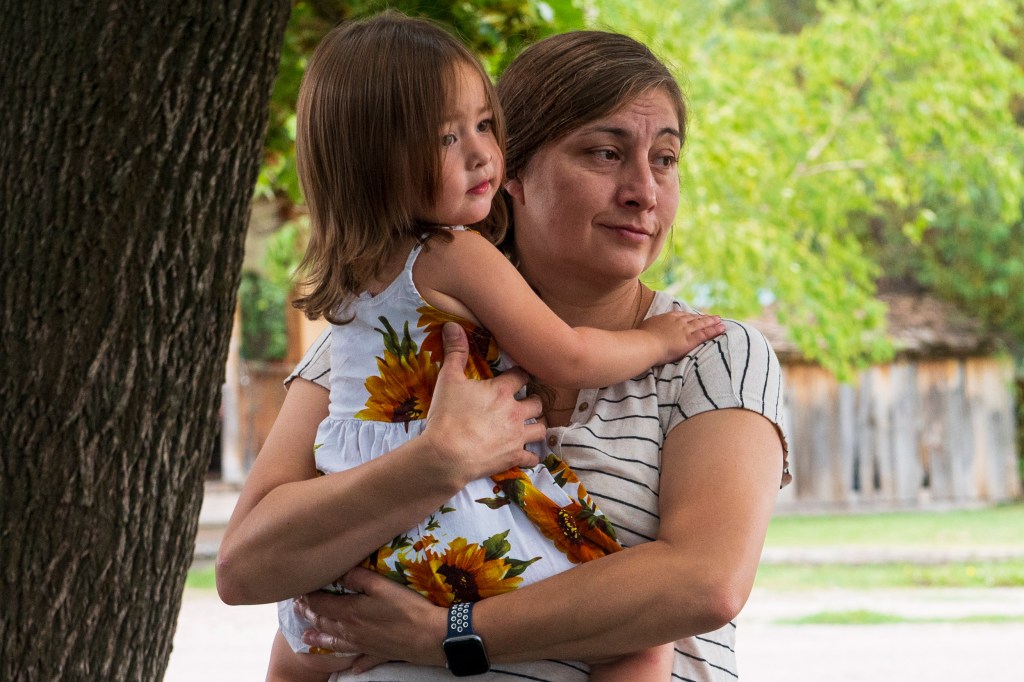
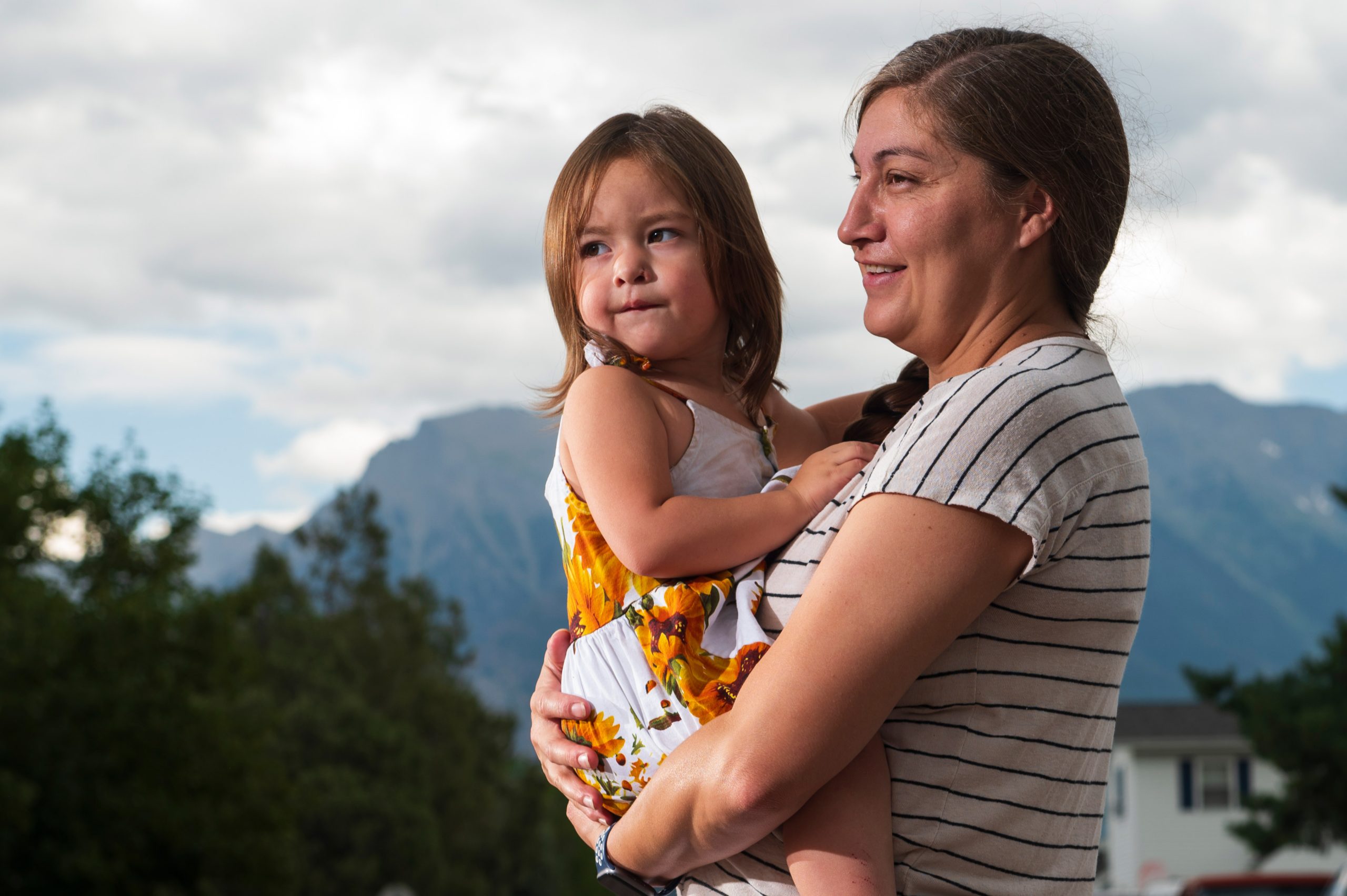
For the most part, Keyanna Jones and her husband thought they knew what to expect when their daughter Chloë had eye surgery last fall.

Even Chloë, who was in kindergarten, had a good understanding of how things would go that day. Before the procedure, a hospital worker gave her a coloring book that explained the steps of the surgery — a procedure to correct a condition that could have eventually interfered with her vision.

“Chloë is very smart,” Jones said. “She reads at almost a third-grade level now, and she’s only 6.”

Jones did her homework, too. With no pediatric ophthalmologists near their home in Wentzville, Missouri, who would take their insurance, she asked the insurer to cover Chloë’s out-of-network care as if it were in-network. The insurer agreed to let her see an out-of-network specialist.

Chloë made it through surgery without a hitch. Jones said her daughter enjoyed a few popsicles at the hospital before going home.

“ I slept with her every night because she was so worried she would wake up and not be able to see,” she said. “But it healed beautifully, and she was absolutely ready to go back to school.”

Then the bill came.

The Medical Procedure

Chloë was born with a droopy left eyelid, a condition known as ptosis. To correct the problem, an ophthalmologist surgically lifts the eyelid, preventing it from disrupting the patient’s line of sight.

Ophthalmologists, unlike optometrists and opticians, hold medical degrees and can provide advanced eye care, including surgery.

The Final Bill

$15,188, including $10,382 for the procedure and $2,730 for anesthesia. Initially, insurance paid just $1,775.79, leaving the Jones family owing $13,412.21 — until Chloë’s uncle, who had recently finished his term as a state senator, asked a colleague to look into it.

The Problem: Phantom Insurance Approval?

Months before Chloë inhaled bubblegum-scented anesthetic at Cardinal Glennon Children’s Hospital in St. Louis, Jones discovered that it can be hard to find a pediatric ophthalmologist. The doctor recommended by Chloë’s pediatrician wasn’t contracted with their insurer, UnitedHealthcare, and the closest in-network specialist was in Wisconsin, hundreds of miles away.

So Jones requested what’s called a network gap exception, under which the insurer would cover the recommended doctor’s services as in-network.

Before the surgery was scheduled, she received a letter saying UnitedHealthcare had approved her request “because currently there isn’t a doctor, health care professional, or facility in your area to provide these services.” The letter listed several medical billing codes for eye services and said they would be covered “at the network level.”

About a week later, the insurer sent a prior authorization letter approving Chloë’s surgery.

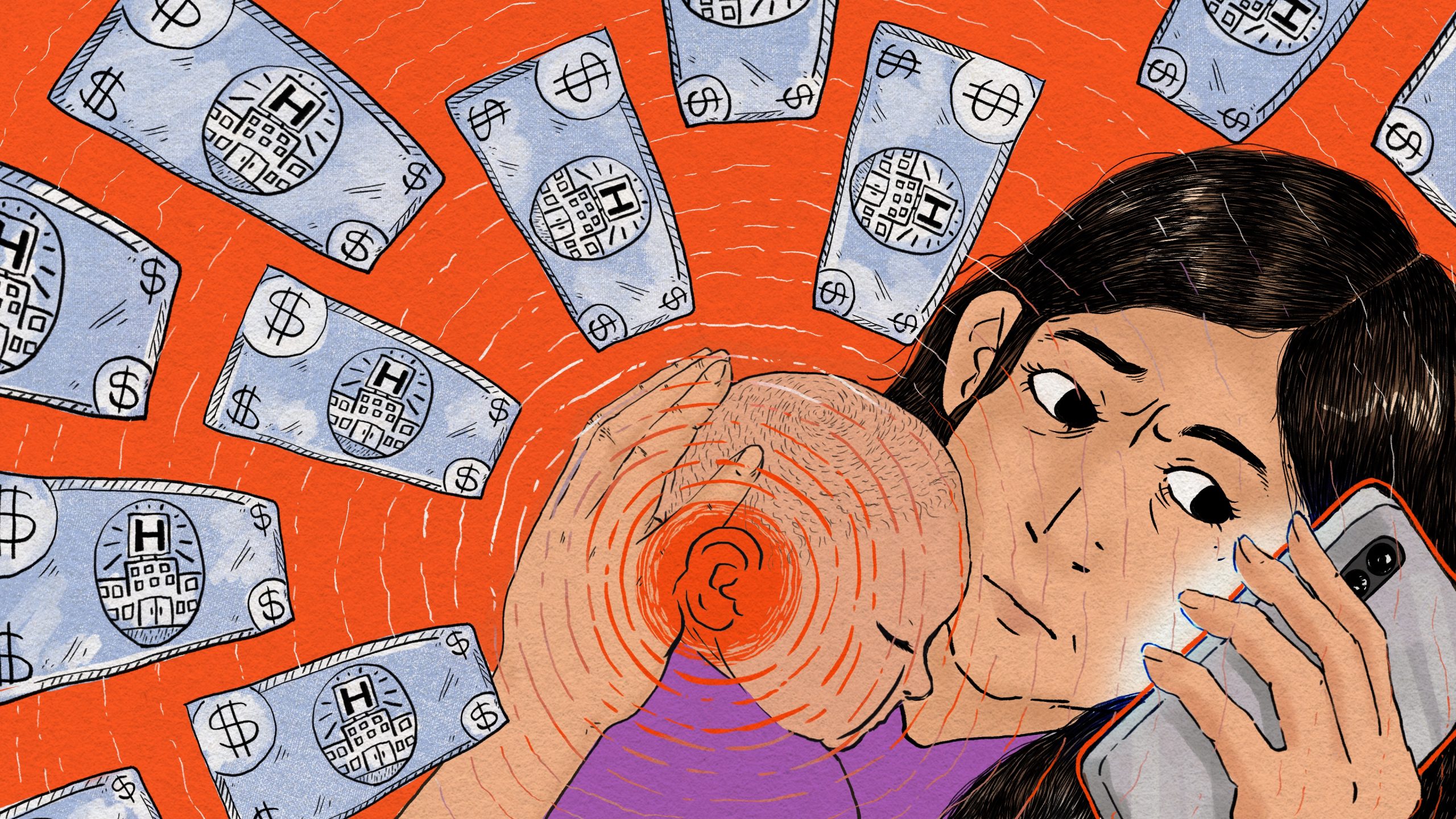
But UnitedHealthcare declined to pay most of the surgery bill, covering it as out-of-network. With approval letters in hand, Jones said, she did not understand why the insurer apparently was not honoring its agreement to cover her daughter’s treatment.

In fact, the similar-looking letters granted different kinds of approval.

UnitedHealthcare’s gap exception approved Chloë’s exams before the surgery as in-network. But in its prior authorization letter for her surgery with the same doctor, the insurer said only that it would cover it — without offering network discounts.

After receiving the bill, Jones contacted the insurer online, but she said a representative told her there was no record of its approval to cover the surgery as in-network.

“At that point, I didn’t even know what to do,” she said. “I’m like, ‘This is crazy.’”

She said she sent over a copy of one of the approval letters, which was on the company’s letterhead, but a representative told her the letter hadn’t come from UnitedHealthcare.

“They said, ‘You saw this surgeon, they’re not covered and you didn’t have permission, so, no, we’re not going to pay,’” Jones said, recounting the phone call.

An insurance representative told Jones she owed more than $13,000 because of “a balance billing issue.” That meant the Jones family would have to pay the $13,000-plus balance.

Spokespeople for UnitedHealthcare confirmed the company provided a gap exception and prior authorization for Chloë’s care. Eric Hausman, a spokesperson for UnitedHealth Group, said in a statement to KFF Health News that “we empathize with anyone who finds themselves in the unfortunate situation of being balance billed by an out-of-network provider for an amount significantly above market rates, and without any advance knowledge.”

Maryanne Wallace, a spokesperson for SSM Health, the health system that includes Cardinal Glennon Children’s Hospital, provided a statement that said SSM followed “standard patient billing procedures.”

“Occasionally, an insurance company may process a claim as an out-of-network service, which can result in a balance being billed to the patient,” the statement said.

The Resolution

Jones said she was blindsided by the big bill. She tried to fix the problem on her own, she said, keeping track of every interaction with the insurer and the hospital. She filed appeals with UnitedHealthcare.

Nothing helped — until she reached out to her brother Caleb Rowden, who had been a Missouri state senator for eight years after serving four years in the state House.

“ I’ve never used my brother’s political clout for anything,” she said. “I actually hate politics.”

Rowden told KFF Health News that he reached out to Travis Fitzwater, the state senator representing his niece’s district. Jones contacted Fitzwater’s office, too, and sent a complaint to Missouri Attorney General Andrew Bailey.

Fitzwater said his office did no more for Chloë than it would for any constituent.

“We’re not going to take a lot of credit for the result of it, because we didn’t ask for anything other than a resolution, so that everybody can be at peace and move on with their lives,” he said in an interview. “We just did what we do every day.”

After Fitzwater’s staff contacted the hospital and the insurer, representatives from both separately called Jones and notified her that UnitedHealthcare had paid the bill in full.

In the end, Chloë’s family paid nothing for her procedure — not even a copay.

The Takeaway

When it comes to insurance approvals, read the fine print carefully; “covered” does not mean an insurer will pay, let alone at in-network rates.

Rowden and Fitzwater said reaching out to your elected representative’s office can help. Advocating for constituents is part of their job.

“They usually have an open line of communication with these insurance companies and hospitals,” Rowden wrote in an email. “They may not always be able to get to a positive outcome since every situation is a little different, but they can usually get you to a next step.”

Jones is grateful that her brother was able to help, though she acknowledged that she probably would not have called him without a nudge from their mother. “I think I would still be fighting,” she said.

Bill of the Month is a crowdsourced investigation by KFF Health News and The Washington Post’s Well+Being that dissects and explains medical bills. Since 2018, this series has helped many patients and readers get their medical bills reduced, and it has been cited in statehouses, at the U.S. Capitol, and at the White House. Do you have a confusing or outrageous medical bill you want to share? Tell us about it!

KFF Health News is a national newsroom that produces in-depth journalism about health issues and is one of the core operating programs at KFF—an independent source of health policy research, polling, and journalism. Learn more about KFF.

USE OUR CONTENT

This story can be republished for free (details).

Estos son los aumentos de precios que también deberían preocuparte

Preocupados por la inflación, los estadounidenses han estado atentos a precios de productos cotidianos como los huevos y la gasolina. Pero un gasto menos conocido debería causar más alarma: el aumento de las primas de los seguros médicos. Llevan años subiendo, y ahora lo están haciendo a un ritmo sin precedentes.

Hay que considerar que, entre 2000 y 2020, el precio de los huevos fluctuó entre poco menos de $1 y aproximadamente $3 la docena; alcanzó los $6,23 en marzo, pero luego bajó a $3,78 en junio.

El precio promedio de la gasolina, tras oscilar entre $2 y $4 el galón durante más de una década a partir de 2005, alcanzó un máximo de $4,93 en 2022 y recientemente volvió a bajar a poco más de $3.

Mientras tanto, desde 1999, las primas de los seguros médicos para las personas con cobertura médica a través del empleador se han más que cuadruplicado. Solo entre 2023 y 2024, aumentaron más del 6% tanto para la cobertura individual como familiar, un alza más pronunciada que la de los salarios y la inflación general.

Para muchas personas que tienen planes médicos creados por la Ley de Cuidado de Salud a Bajo Precio (ACA) —porque trabajan para pequeñas empresas o pagan su propia cobertura— es probable que las tarifas hayan aumentado de forma aún más drástica. En este mercado, los reguladores estatales examinan minuciosamente los aumentos de tarifas propuestos por las aseguradoras, pero solo si superan el 15%.

Y la situación está a punto de empeorar: para 2026, las aseguradoras en los mercados de ACA han propuesto nuevos precios exorbitantes: en Nueva York, UnitedHealthcare propuso un aumento del 66,4%. HMO Colorado solicitó un aumento promedio de más del 33% en ese estado. En Washington, el aumento promedio propuesto por todas las aseguradoras es del 21,2%, y en Rhode Island es del 23,7%.

Según Business Group on Health, un consorcio de grandes empleadores, “los costos reales de la atención médica han aumentado un 50% acumulado desde 2017”. En una encuesta independiente publicada en 2021, el 87% de las empresas afirmó que, en los próximos cinco a 10 años, el costo de proporcionar seguro médico a sus trabajadores se volvería “insostenible”.

Y las aseguradoras del mercado de ACA están aumentando las primas un promedio del 20% para el próximo año, según un nuevo análisis. Imaginemos que los pagos de alquiler o hipoteca de decenas de millones de estadounidenses aumentaran repentinamente en esa cantidad.

En teoría, los que regulan los seguros podrían exigir que se redujeran las tarifas propuestas, y esto sucede a menudo. Sin embargo, algunos estados son más activos que otros en este sentido. Y todos temen que una interferencia regulatoria excesiva pueda expulsar a las aseguradoras de sus mercados.

Las aseguradoras ofrecen muchas explicaciones para sus cálculos, algunas de las cuales están relacionadas con las recientes medidas del Congreso y del presidente Donald Trump.

Por ejemplo, se espera que los nuevos aranceles a los socios comerciales de Estados Unidos aumenten el costo de los medicamentos y los suministros médicos. Mientras tanto, las reducciones en el gasto en salud incluidas en el proyecto de ley de presupuesto del Partido Republicano, junto con la expiración de algunos subsidios a las primas de la era Biden a finales de este año, provocarán que muchas personas pierdan su seguro médico.

Se prevé que cerca de 16 millones de estadounidenses se quedarán sin seguro en 2034, en muchos casos porque mantenerlo se volverá inasequible.

Dado que es probable que la mayoría de estas personas sean jóvenes o sanas, el grupo de riesgo de quienes permanezcan asegurados será mayor y más enfermo, y por lo tanto, más costoso de cubrir.

“En última instancia, creemos que el mercado de ACA probablemente será más pequeño y estará más orientado a la necesidad del paciente el próximo año”, escribió Janey Kiryluik, vicepresidenta de comunicaciones corporativas de Elevance Health (anteriormente conocida como Anthem), en un correo electrónico. Agregó: “Nuestra postura refleja una acción disciplinada temprana”.

Recuerda que la mayoría de las aseguradoras en el país son empresas públicas con fines de lucro; por lo tanto, tienden a actuar en beneficio de sus accionistas, no de los pacientes cuya atención médica cubren.

Las grandes empresas que gestionan sus propios planes de salud podrían negociar mejores condiciones para sus trabajadores. Pero las empresas más pequeñas, en su mayoría, tendrán que aceptar las ofertas.

Las primas no son el único aspecto del seguro médico que se está volviendo más caro. Los deducibles (el dinero que los beneficiarios deben pagar de su bolsillo antes que el seguro entre en vigencia) también están aumentando. El deducible promedio para un plan plata estándar de ACA en 2025 era de casi $5.000, aproximadamente el doble que en 2014. (Para quienes tienen seguro médico a través de su empleador, el promedio es de poco menos de $2.000).

Algunos estados intentan frenar la tendencia ofreciendo una “opción pública” estatal, un plan de seguro básico y asequible que los pacientes pueden elegir. Sin embargo, han tenido dificultades porque una tasa de pago más baja para los trabajadores generalmente significa menos proveedores participantes y un acceso reducido a la atención médica.

Si los votantes prestaran tanta atención al precio del seguro médico como al costo de la gasolina y los huevos, tal vez los funcionarios electos responderían con más medidas.

KFF Health News is a national newsroom that produces in-depth journalism about health issues and is one of the core operating programs at KFF—an independent source of health policy research, polling, and journalism. Learn more about KFF.

USE OUR CONTENT

This story can be republished for free (details).

As Measles Exploded, Officials in Texas Looked to CDC Scientists. Under Trump, No One Answered.

As measles surged in Texas early this year, the Trump administration’s actions sowed fear and confusion among CDC scientists that kept them from performing the agency’s most critical function — emergency response — when it mattered most, an investigation from KFF Health News shows.

The outbreak soon became the worst the United States has endured in over three decades.

In the month after Donald Trump took office, his administration interfered with Centers for Disease Control and Prevention communications, stalled the agency’s reports, censored its data, and abruptly laid off staff. In the chaos, CDC experts felt restrained from talking openly with local public health workers, according to interviews with seven CDC officials with direct knowledge of events, as well as local health department emails obtained by KFF Health News through public records requests.

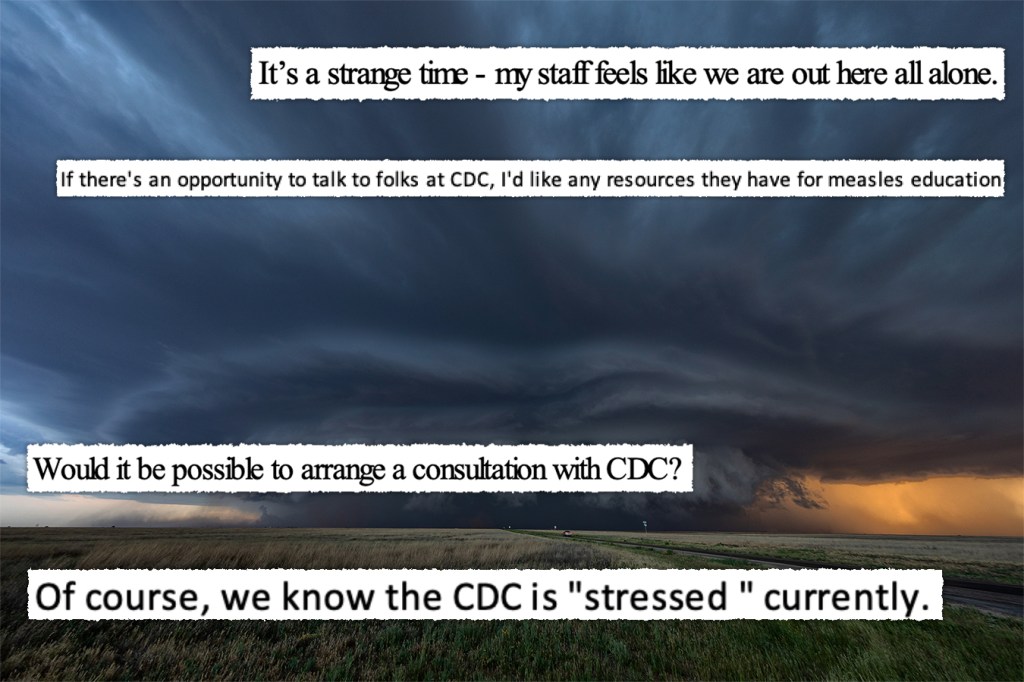
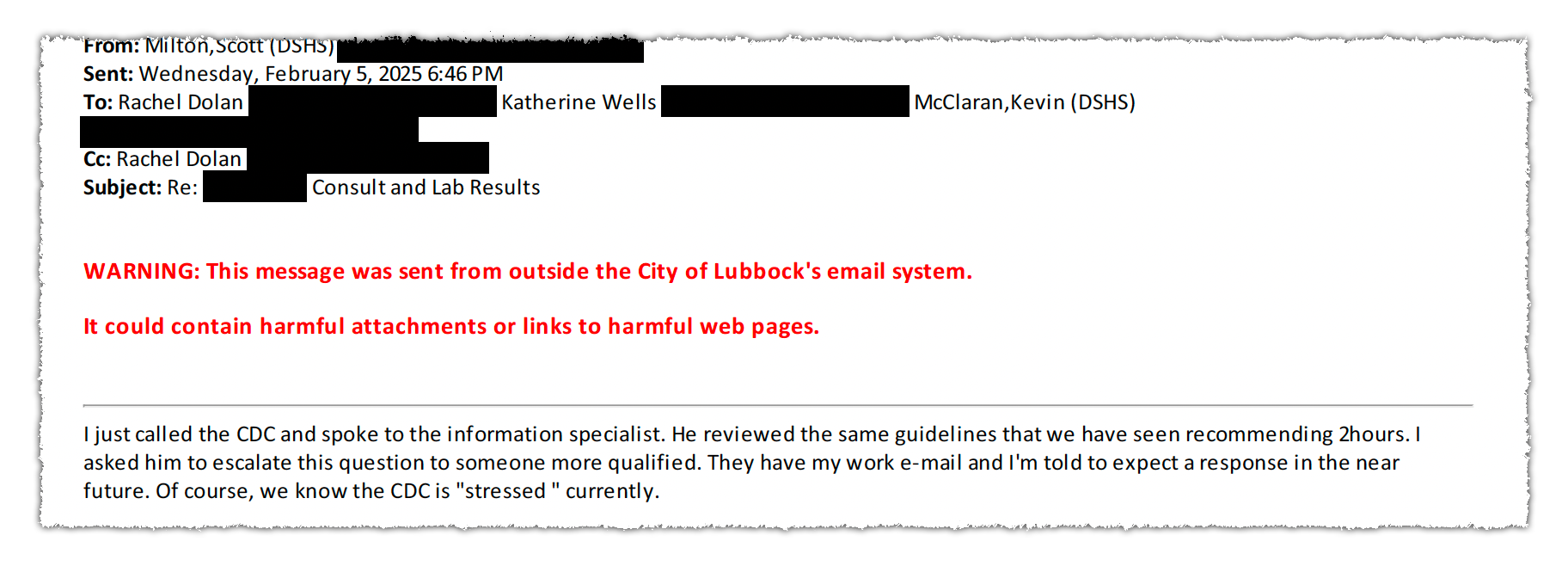
“CDC hasn’t reached out to us locally,” Katherine Wells, the public health director in Lubbock, Texas, wrote in a Feb. 5 email exchange with a colleague two weeks after children with measles were hospitalized in Lubbock. “My staff feels like we are out here all alone,” she added.

A child would die before CDC scientists contacted Wells.

“All of us at CDC train for this moment, a massive outbreak,” one CDC researcher told KFF Health News, which agreed not to name CDC officials who fear retaliation for speaking with the press. “All this training and then we weren’t allowed to do anything.”

Delays have catastrophic consequences when measles spreads in undervaccinated communities, like many in West Texas. If a person with measles is in the same room with 10 unvaccinated people, nine will be infected, researchers estimate. If those nine go about their lives in public spaces, numbers multiply exponentially.

The outbreak that unfolded in West Texas illustrates the danger the country faces under the Trump administration as vaccination rates drop, misinformation flourishes, public health budgets are cut, and science agencies are subject to political manipulation.

While the Trump administration stifled CDC communications, health secretary Robert F. Kennedy Jr. fueled doubt in vaccines and exaggerated the ability of vitamins to ward off disease. Suffering followed: The Texas outbreak spread to New Mexico, Oklahoma, Kansas, Colorado, and Mexico’s Chihuahua state — at minimum. Together these linked outbreaks have sickened more than 4,500 people, killed at least 16, and levied exorbitant costs on hospitals, health departments, and those paying medical bills.

“This is absolutely outrageous,” said Jennifer Nuzzo, director of the Pandemic Center at Brown University. “When you’re battling contagious diseases, time is everything.”

‘The CDC Is “Stressed” Currently’

Wells was anxious the moment she learned that two unvaccinated children hospitalized in late January had the measles. Hospitals are legally required to report measles cases to health departments and the CDC, but Wells worried many children weren’t getting tested.

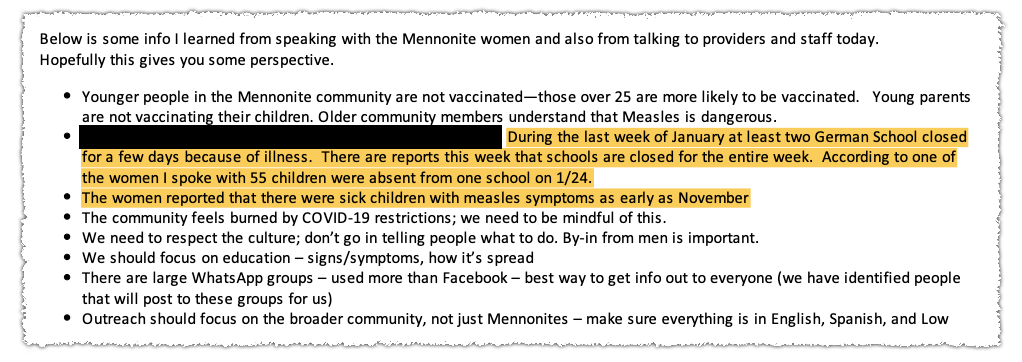
“I think this may be very large,” she wrote in a Feb. 3 email to the Texas Department of State Health Services. Wells relayed in another email what she’d learned from conversations around town: “According to one of the women I spoke with 55 children were absent from one school on 1/24. The women reported that there were sick children with measles symptoms as early as November.”

In that email and others, Wells asked state health officials to put her in touch with CDC experts who could answer complicated questions on testing, how to care for infants exposed to measles, and more. What transpired was a plodding game of telephone.

One email asked whether clinics could decontaminate rooms where people with measles had just been if the clinics were too small to follow the CDC’s recommendation to keep those rooms empty for two hours.

“Would it be possible to arrange a consultation with the CDC?” Wells wrote on Feb. 5.

“It never hurts to ask the CDC,” said Scott Milton, a medical officer at the Texas health department. About 25 minutes later, he told Wells that an information specialist at the CDC had echoed the guidelines advising two hours.

“I asked him to escalate this question to someone more qualified,” Milton wrote. “Of course, we know the CDC is ‘stressed’ currently.”

Local officials resorted to advice from doctors and researchers outside the government, including those at the Immunization Partnership, a Texas nonprofit.

“The CDC had gone dark,” said Terri Burke, executive director of the partnership. “We had anticipated a measles outbreak, but we didn’t expect the federal government to be in collapse when it hit.”

Technically, the Trump administration’s freeze on federal communications had ended Feb. 1. However, CDC scientists told KFF Health News that they could not speak freely for weeks after.

“There was a lot of confusion and nonanswers over what communications were allowed,” one CDC scientist said.

Georges Benjamin, executive director of the American Public Health Association, said the situation was not unique to measles. “Like most public health organizations, we weren’t able to get ahold of our program people in February,” he said. Information trickled out through the CDC’s communications office, but CDC scientists gave no press briefings and went dark on their closest partners across the country. “The CDC was gagged,” he said.

Through private conversations, Benjamin learned that CDC experts were being diverted to remove information from websites to comply with executive orders. And they were afraid to resume communication without a green light from their directors or the Department of Health and Human Services as they watched the Trump administration lay off CDC staffers in droves.

“It’s not that the CDC was delinquent,” Benjamin said. “It’s that they had their hands tied behind their backs.”

To work on the ground, the CDC needs an invitation from the state. But Anne Schuchat, a former CDC deputy director, said that during her 33 years with the agency, federal health officials didn’t need special permission to talk freely with local health departments during outbreaks. “We would always offer a conversation and ask if there’s anything we could do,” she said.

Lara Anton, a press officer at the Texas health department, said the state never prevented the CDC from calling county officials. To learn more about the state’s correspondences with the CDC, KFF Health News filed a public records request to the Texas health department. The department refused to release the records. Anton called the records “confidential under the Texas Health and Safety Code.”

Anton said the state sent vaccines, testing supplies, and staff to assist West Texas in the early weeks of February. That’s corroborated in emails from the South Plains Public Health District, which oversees Gaines County, the area hit hardest by measles.

“Texas will try to handle what it needs to before it goes to the CDC,” Zach Holbrooks, the health district’s executive director, told KFF Health News.

Responding to an outbreak in an undervaccinated community, however, requires enormous effort. To keep numbers from exploding, public health workers ideally would notify all people exposed to an infected person and ask them to get vaccinated immediately if they weren’t already. If they declined, officials would try to persuade them to avoid public spaces for three weeks so that they wouldn’t spread measles to others.

Holbrooks said this was nearly impossible. Cases were concentrated in close-knit Mennonite communities where people relied on home remedies before seeking medical care. He said many people didn’t want to be tested, didn’t want to name their contacts, and didn’t want to talk with the health department. “It doesn’t matter what resources I have if people won’t avail themselves of it,” Holbrooks said.

Historically, Mennonites faced persecution in other countries, making them leery of interacting with authorities, Holbrooks said. A backlash against covid restrictions deepened that mistrust.

Another reason Mennonites may seek to avoid authorities is that some live in the U.S. illegally, having immigrated to Texas from Canada, Mexico, and Bolivia in waves over the past 50 years. Locals guess the population of Seminole, the main city in Gaines County, is far larger than the U.S. Census count.

“I have no idea how many cases we might have missed, since I don’t know how many people are in the community,” Holbrooks said. “There’s a lot of people in the shadows out here.”

Public health experts say the situation in Gaines sounds tough but familiar. Measles tends to take hold in undervaccinated communities, and therefore public health workers must overcome mistrust, misinformation, language barriers, and more.

About 450 people — including local health officials, CDC scientists, nurses, and volunteers — helped control a measles outbreak sparked in an Eastern European immigrant community in Clark County, Washington, in 2018.

Alan Melnick, Clark County’s public health director, said his team spoke with hundreds of unvaccinated people who were exposed. “We were calling them basically every day to see how they were doing and ask them not to go out in public,” he said.

Melnick spoke with CDC scientists from the start, and the intensity of the response was buoyed by emergency declarations by the county and the state. Within a couple of months, the outbreak was largely contained. No one died, and only two people were hospitalized.

In New York, hundreds of people in the city’s health department responded to a larger measles outbreak in 2018 and 2019 concentrated among Orthodox Jewish communities. The work included meeting with dozens of rabbis and distributing booklets to nearly 30,000 households to combat vaccine misinformation.

The effort cost more than $7 million, but Jane Zucker, New York City’s assistant health commissioner at the time, said it yielded immense savings. The average medical bill for measles hospitalizations is roughly $18,500, according to data from prior outbreaks. Then there’s the cost of diverting hospital resources, of children missing school, of parents staying home from work to care for sick kids, and the lasting toll of some measles infections, including deafness or worse.

“I don’t think there’s a price tag to put on a child’s death that would otherwise be prevented,” Zucker said.

Local health departments in West Texas were understaffed from the start. About 18 people work at the South Plains health department, which oversees four vast rural counties. About 50 staff the department in Lubbock, where patients were hospitalized and health workers struggled to figure out who was exposed. In mid-February, Wells emailed a colleague: “I’m so overwhelmed.”

A Death Ignites a Response

On Feb. 26, Texas announced that a 6-year-old child had died of measles. Wells heard from CDC scientists for the first time the following day. Also that day, the CDC issued a brief notice on the outbreak. The notice recommended vaccines, but it worried public health specialists because it also promoted vitamin A as a treatment under medical supervision.

In emails, Texas health officials privately discussed how the CDC’s notice might exacerbate a problem: Doctors were treating children with measles for toxic levels of vitamin A, suggesting that parents were delaying medical care and administering the supplements at home. A local Lubbock news outlet reported on a large drugstore where vitamin A supplements and cod liver oil, which contains high levels of vitamin A, were “flying off the shelf.”

Too much vitamin A can cause liver damage, blindness, and dire abnormalities during fetal development.

Milton worried that parents were listening to misinformation from anti-vaccine groups — including one founded by Kennedy — that diminished the need for vaccination by inaccurately claiming that vitamin A staved off the disease’s worst outcomes.

“How many people will choose Vitamin A and not a vaccine because it appears to them there are two options?” Milton asked in an email.

Scientists at the CDC privately fretted, too. “HHS pressed us to insert vitamin A into all of our communications with clinicians and health officials,” one CDC scientist told KFF Health News, referring to the agency’s notices and alerts. “If pregnant women took too much vitamin A during the outbreak, their babies could be profoundly disabled. We haven’t seen those babies born yet.”

Another CDC official said they’ve had to “walk a fine line” between protecting the public based on scientific evidence and aligning with HHS.

While CDC scientists held their tongues, Kennedy exaggerated the power of nutrition and vitamin A while furthering mistrust in vaccines. “We’re providing vitamin A,” Kennedy said in an interview on Fox News. “There are many studies, some showing 87% effectiveness,” he claimed, “against serious disease and death.”

The studies Kennedy referenced were conducted in low-income countries where children are malnourished. Evidence suggests that vitamin A supplementation is seldom useful against measles in the United States, because deficiency is exceedingly rare.

Kennedy deflected criticism from those who call him anti-vaccine, saying that any parent in Texas who wants a measles vaccine can get one. He followed this with dangerously inaccurate statements. “There are adverse events from the vaccine. It does cause deaths every year,” he said. “It causes all the illnesses that measles itself causes, encephalitis and blindness, et cetera.” There is no evidence that measles vaccines “cause deaths every year.” Scores of studies show that the vaccine doesn’t cause encephalitis, that most potential side effects resolve quickly on their own, and serious adverse reactions are far rarer than measles complications.

In another interview, Kennedy said, “The MMR vaccine contains a lot of aborted fetus debris.” The measles, mumps, and rubella, or MMR, vaccine does not contain an iota of fetal cells.

HHS spokesperson Andrew Nixon and spokespeople at the CDC did not respond to queries from KFF Health News.

‘Staff Are Exhausted’

Despite national attention after the country’s first measles death in a decade, West Texas was overwhelmed. In late February and March, hospital administrators and health officials exchanged emails about how to lobby for resources.

“Local hospitals are at capacity,” wrote Jeffrey Hill, a senior vice president at the University Medical Center Health System in Lubbock. “The state reports emergency funds that typically cover a response like the measles outbreak are not available from the federal government right now,” he added.

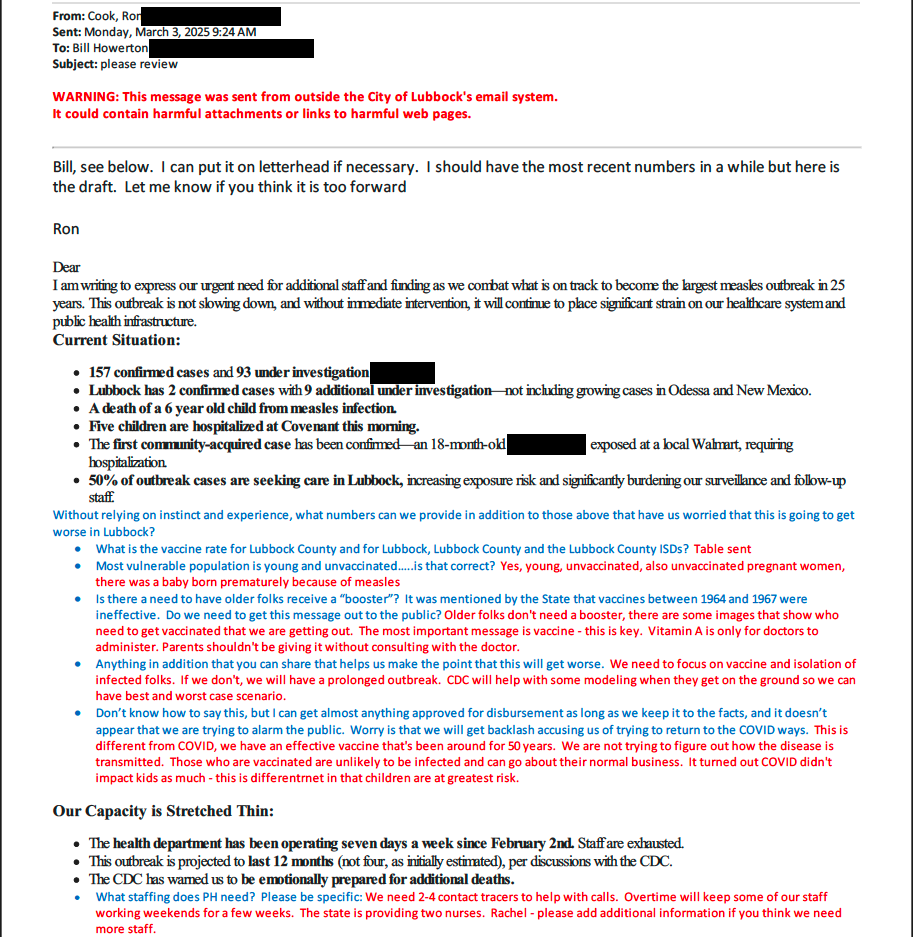
“I am writing to express our urgent need for additional staff and funding,” Ronald Cook, medical director for Lubbock, said in an email, drafted with other Lubbock health authorities, to the deputy city manager. “Our Capacity is Stretched Thin: The health department has been operating seven days a week since February 2nd. Staff are exhausted.”

The city of Lubbock fronted money to help the local health department hire temporary staff. The state did not provide money, but it asked the CDC to send epidemiologists. Some came to Texas in early March. Then Texas requested federal funds.

None arrived, even as the outbreak approached 500 cases. It spread to Mexico when an unvaccinated Mennonite child returned home after visiting family in Seminole. This would fuel the largest outbreak Mexico has seen in decades, with at least 3,700 cases and 13 deaths in the state of Chihuahua.

Then another child in West Texas died of measles.

In a rare moment of openness, CDC scientist David Sugarman mentioned the outbreak at a vaccine advisory meeting in late April. “There are quite a number of resource requests coming in, in particular from Texas,” Sugarman said. “We are scraping to find the resources and personnel needed to provide support to Texas and other jurisdictions.”

Federal funds arrived in Texas on May 21, said Anton, the state health department spokesperson. By then, the crisis was fading. The outbreak seemed to have burned until every unvaccinated person in Seminole was infected, said Richard Eby, a doctor at Permian Regional Medical Center who treated some measles patients. Hundreds, if not thousands, of cases have probably gone undetected, he said. “A lot of people presumed their kids had measles,” he said, “and didn’t see the need to confirm it.”

On Aug. 18, health officials declared the West Texas outbreak over, but the consequences of the catastrophe will be lasting.

The outbreaks it sparked across the U.S. and Mexico are still spreading.

More are inevitable, Nuzzo said. A growing number of parents are deciding not to vaccinate their kids, worried over unfounded rumors about the shots. Misinformation is flourishing, especially after Kennedy fired vaccine experts who advise the CDC and replaced them with doctors and researchers on the fringes of the scientific establishment. For example, one of his recent appointees, Robert Malone, blamed the deaths of children with measles on “medical mismanagement,” without evidence.

At the same time, states are downsizing programs for emergency response, disease surveillance, and immunization after the Trump administration clawed back more than $11 billion in public health funds earlier this year.

Amid Lubbock’s toughest months, Wells sent an email to the department’s exhausted staff. “The future is uncertain, and I know this is an unsettling time for many of us,” she wrote. “Every day we show up and do our jobs is an act of resilience.”

KFF Health News is a national newsroom that produces in-depth journalism about health issues and is one of the core operating programs at KFF—an independent source of health policy research, polling, and journalism. Learn more about KFF.

USE OUR CONTENT

This story can be republished for free (details).

FTC Has Long Said Products Must Back Up Health Claims. A MAHA Lawsuit Would Upend That.

Don’t get Nathan Jones started on xylitol, the active ingredient in his chewing gum, nasal spray, and other products. He’ll talk your ear off about its wondrous powers against tooth decay, as well as its potential to fight covid, heart disease, Alzheimer’s — you name it.

For now, Jones, the founder of Xlear, can’t make those claims in his company’s advertising. But if the lawsuit his company brought against the Federal Trade Commission succeeds, he’ll likely be able to say anything he wants.

As the Trump administration loosens enforcement by the Federal Trade Commission, Department of Justice, and FDA of unproven health claims, Jones and his allies in the “medical freedom” movement are pushing to permanently roll back the health regulatory state.

For decades, the FTC has required companies to back any medical claims about their products with substantial evidence, while taking actions against hundreds of “bogus health cures,” said Jessica Rich, the FTC’s director of consumer protection from 2013 to 2017.

If successful, the lawsuit by Jones’ company “would be a complete game changer,” said Mary Engle, associate director of the FTC’s advertising practices division from 2001 to 2020.

The FTC — and FDA — don’t have sufficient staffing to rigorously police health claims, but Health and Human Services Secretary Robert F. Kennedy Jr.’s allies in the alternative medicine world have suggested that the agencies already go too far.

“The pharmaceutical industry has a stranglehold and monopoly in America,” Jones told KFF Health News. “The consumer should have a choice in what they’re doing and how they’re being proactive and reactive in their health care.”

Jones and other members of the Alliance for Natural Health USA, which includes alternative medicine practitioners, vaccine skeptics, and proponents of “natural” remedies, were elated when Kennedy became Health and Human Services secretary in February. One called it a “once-in-a-lifetime opportunity.”

Kennedy had warned shortly before Trump’s reelection that the FDA would face a reckoning for its “aggressive suppression” of vitamins, peptides, nutraceuticals, and other products from a supplement industry that has sought more freedom to make claims about its products.

Losing Regulatory Bite?

For decades, the FDA has had the power to recall dangerous products and check health claims, although it has nowhere near the workforce it would need to police the vast $70 billion supplement industry.

The FTC has traditionally had more teeth, successfully suing companies that make unsubstantiated claims. For example, the agency won a judgment last year against a company that advertised a supplement as “clinically shown” to improve memory.

The FTC under Trump has not announced any new enforcement actions against supplement makers (it did send consumers the proceeds of previous fraud settlements), and the administration has reversed several covid-related FTC actions. In March, the FTC dropped a lawsuit filed in 2021 against Jones and Xlear over the marketing of its “drug-free” sinus rinse as a covid preventive and treatment. The Department of Justice also closed a case brought on behalf of the FTC and the FDA against a company that claimed its Earth Tea could cure covid.

In June, Jones, who says he spent $3 million fighting the FTC suit before it was dropped, sued back. The company asked a judge to forbid the FTC from requiring that health product marketers back their claims with convincing evidence, such as clinical trials — a position the FTC has maintained since 1984.

Xlear hopes the suit will be considered under last year’s Supreme Court ruling known as Loper Bright, said Xlear attorney Rob Housman. That ruling gave courts more power to second-guess federal agencies’ interpretation of the laws that govern their activities.

The Alliance for Natural Health joined Xlear in a separate petition in May demanding that the FTC drop its requirement for companies to provide substantial evidence backing health claims, and to withdraw 2022 guidelines that generally require companies to run a randomized clinical trial to prove their claims.

The petition was filed by Jonathan Emord, a lawyer who has successfully fought FDA and FTC regulation of supplements and unsuccessfully ran for governor of Virginia as a Republican in the 2024 primary.

Emord’s petition seeks to flip the burden of proof. Instead of requiring the makers of supplements and cosmetic creams, pills, sprays, and herbals to prove their products do what they claim to do, the government would have to prove that they don’t.

“If an advertiser throws caution to the wind and makes a health-related product claim without resort to any supporting evidence, the FTC is powerless” to stop it, Emord wrote in the petition. “Rather, the claim will be tested in the idea and information market free of government constraint.”

Emord and the Alliance for Natural Health did not respond to repeated requests for comment.

The FTC would not comment on the lawsuit, the petition, or the issue of substantiation in general, spokesperson Juliana Gruenwald Henderson said.

Shorthanded and Mostly Hands-Off

Meanwhile, with Kennedy’s administration chockablock with proponents of nontraditional health products, “there’s been a downtick of enforcement,” Housman said.

Since Trump took office, the FTC has lost at least a quarter of the staff in its Division of Advertising Practices, which took the original action against Xlear, said Serena Viswanathan, who retired as FTC associate director in June. The Department of Justice has reorganized its consumer protection unit, which backed the FTC in many actions, and moved some of its lawyers to immigration and other areas.

In one of the only actions it has taken against deceptive health practices under Trump, the FTC hosted a July 9 workshop titled “The Dangers of ‘Gender-Affirming Care’ for Minors.”

In FTC Chairman Andrew Ferguson’s opening statement at that event, he excoriated the Biden administration for allowing hormonal and surgical treatments for youth experiencing gender dysphoria.

But Ferguson justified the FTC’s new attack on these treatments by referring to the agency’s traditional practice of pursuing companies for making false and deceptive claims. Noting the agency’s past actions against “shyster snake oil salesmen” promoting fake cures, Ferguson highlighted the Biden-era FTC’s position that “health claims need to be backed up by reliable scientific evidence” and an “incredibly high standard of scientific ‘substantiation.’”

Under that logic, Ferguson “has to defend against the Xlear lawsuit,” Rich said.

“If anyone can just hawk health products without any basis, and customers spend money on bogus cures instead of seeking proper care, it’s really a serious issue,” she said.

‘Nanny State’ or Not?

Ferguson’s remarks reflect one of many contradictions in the administration’s approach to health policy. While favoring deregulation and greater personal liberty to consume unregulated supplements, Kennedy has also pushed for stricter FDA oversight of food and drugs, while advocating for behavioral change that GOP officials derided as “nanny state” tactics when Democrats like former first lady Michelle Obama promoted doing so.

Kennedy, for example, has said he wants more randomized control trials for vaccines and drugs — a requirement rejected by medical freedom advocates like Jones.

“I like clinical data; I think it’s great,” Housman said. “It’s not the be-all and end-all.”

Kennedy has also announced plans to change a policy that allows food companies to add ingredients without a full safety review. But many supplement makers use the policy to get their products on the market without FDA review, and some are unhappy about the potential clampdown.

Banking on Xylitol

The FDA approved xylitol as a food additive in 1963 and regulates it as a cosmetic ingredient. Jones, who said his company has about 110 employees and sells to 70,000 retailers, founded Xlear 25 years ago.

Jones expresses skepticism of vaccines, believes the drug industry has a monopolistic stranglehold on health care, and is a “true believer” in xylitol, Housman said.

In an interview with KFF Health News, Jones said that the slightly sweet, minty-flavored substance reduces gum inflammation by blocking the adhesion of tooth-rotting Streptococcus mutans bacteria to cells in the mouth.

In Finland, where water is not fluoridated, dentists have long recommended xylitol-imbued chewing gum for children. In addition to fighting cavities and lowering periodontal disease, Jones said, xylitol could fight chronic illnesses like obesity, Alzheimer’s, and heart disease, which “all have a correlation with oral hygiene.”

But “the government bans us from going out and talking about what xylitol does,” he said. “We cannot say xylitol can help prevent tooth decay, because xylitol is not a drug, and that’s a drug claim.”

As for its use against covid, three ear, nose, and throat specialists interviewed by KFF Health News said that xylitol is good for moisturizing nasal cavities, perhaps a bit better than simple saline solution. While there’s no evidence it prevents or cures covid, xylitol, like saline nose washes, may reduce symptoms when used toward the start of any viral upper respiratory infection, said Christine Franzese, a professor of otolaryngology at the University of Missouri Medical Center and the chair of the American Academy of Otolaryngology-Head and Neck Surgery’s allergy, asthma, and immunology committee.

Xylitol is poisonous to dogs, but deemed safe to humans when used at recommended doses in sprays, candies, chewing gum, and other products, according to the American Academy of Pediatric Dentistry, which also states that evidence is mixed on whether xylitol fights cavities effectively.

At higher doses, xylitol can cause diarrhea and other gastrointestinal problems, and a study funded by the National Institutes of Health and published last year found that regular use of xylitol as a sweetener could exacerbate heart disease. The quantities of xylitol consumed daily by participants in that study were far higher than what’s in a few sticks of chewing gum, however.

Whether his lawsuit succeeds or not, Jones can probably expect a rosy business future.

On May 21, he and pediatric dentist Mark Cannon of Northwestern University were called to testify in the Utah Legislature in support of a pilot project to provide Xlear’s gum to students and prisoners in the state as a replacement for fluoridated water, which the state banned in March.

Florida ordered fluoride removed from the state’s water starting July 1, and other states are considering bans. Kennedy wants to end fluoridation nationwide, despite widespread skepticism of his belief that it poisons the brain at common dosing levels.

The bans are a boon to Xlear, Jones said. The company would provide gum for the Utah pilot at cost, he said, but if governments promote it and people learn more, “that’s where we see us being able to grow.”

KFF Health News is a national newsroom that produces in-depth journalism about health issues and is one of the core operating programs at KFF—an independent source of health policy research, polling, and journalism. Learn more about KFF.

USE OUR CONTENT

This story can be republished for free (details).
The Price Increases That Should Cause Americans More Alarm

Wary of inflation, Americans have been watching the prices of everyday items such as eggs and gasoline. A less-noticed expense should cause greater alarm: rising premiums for health insurance. They have been trending upward for years and are now rising faster than ever.

Consider that, from 2000 to 2020, egg prices fluctuated between just under $1 and about $3 a dozen; they reached $6.23 in March but then fell to $3.78 in June. Average gas prices, after seesawing between $2 and $4 a gallon for more than a decade starting in 2005, peaked at $4.93 in 2022 and recently fell back to just over $3.

Meanwhile, since 1999, health insurance premiums for people with employer-provided coverage have more than quadrupled. From 2023 to 2024 alone, they rose more than 6% for both individuals and family coverage — a steeper increase than that of wages and overall inflation.

For many people who have the kind of insurance plans created by the Affordable Care Act (because they work for small companies or insure themselves), rates have probably risen even more drastically. In this market, state regulators scrutinize insurers’ proposed rate increases, but only if they exceed 15%.

And the situation is about to get worse: For 2026, ACA marketplace insurers have proposed eye-popping new prices: In New York, UnitedHealthcare has proposed a 66.4% rise. HMO Colorado has asked for an average increase of more than 33% in that state. In Washington, the average proposed increase across all insurers is 21.2%, and in Rhode Island it’s 23.7%.

According to Business Group on Health, a consortium of major employers, “actual health care costs have grown a cumulative 50% since 2017.” In a separate survey published in 2021, 87% of companies said that in the next five to 10 years, the cost of providing health insurance for their workers would become “unsustainable.”

And insurers in the ACA marketplace are increasing premiums by an average of 20% for next year, according to a new analysis. Imagine if tens of millions of Americans’ rent or mortgage payments were to suddenly increase by that amount.

Insurance regulators theoretically could demand that these proposed rates be lowered — and this often happens. But some states are more active than others in this regard. And all are wary that too much regulatory interference could drive insurers from their markets.

Insurers offer many explanations for their calculations, some of which are tied to recent actions by Congress and President Donald Trump. New tariffs on America’s trading partners, for example, are expected to push up the cost of drugs and medical supplies.

Meanwhile, reductions in health care spending included in the GOP budget bill, along with the expiration of some Biden-era premium subsidies at the end of this year, will cause many people to lose their health insurance. About 16 million Americans are expected to become uninsured by 2034, in many cases because keeping insurance will become unaffordable.

Because most of these people are likely to be young and/or healthy, the “risk pool” of those remaining insured will become older and sicker — and therefore more expensive to cover.

“Ultimately, we believe the ACA market will likely be smaller and higher acuity-driven next year,” Janey Kiryluik, vice president of corporate communications for Elevance Health (formerly known as Anthem), wrote in an email. She added: “Our position reflects early disciplined action.”

Remember, most insurers in the United States are public, for-profit companies; as such, they tend to act in the interests of their shareholders, not the patients whose health care they cover.

Large employers that manage their own health care plans might be able to negotiate better deals for their workers. But smaller companies, for the most part, will need to accept what’s on offer.

Premiums are not the only part of health insurance that’s getting more expensive. Deductibles — the money that beneficiaries must spend out-of-pocket before insurance kicks in — are also rising. The average deductible for a standard ACA silver plan in 2025 was nearly $5,000, about double what it was in 2014. (For those with employer-based insurance, the average number is just under $2,000.)

A few states are trying to stem the tide by offering a state-run “public option,” a basic affordable insurance plan that patients can choose. But they have struggled because a lower payment rate for workers generally means fewer participating providers and reduced access to care.

If voters paid as much attention to the price of health insurance as they do to the cost of gas and eggs, maybe elected officials would respond with more action.

KFF Health News is a national newsroom that produces in-depth journalism about health issues and is one of the core operating programs at KFF—an independent source of health policy research, polling, and journalism. Learn more about KFF.

USE OUR CONTENT

This story can be republished for free (details).
Native Americans Want To Avoid Past Medicaid Enrollment Snafus as Work Requirements Loom

Jonnell Wieder earned too much money at her job to keep her Medicaid coverage when the covid-19 public health emergency ended in 2023 and states resumed checking whether people were eligible for the program. But she was reassured by the knowledge that Medicaid would provide postpartum coverage for her and her daughter, Oakleigh McDonald, who was born in July of that year.

Wieder is a member of the Confederated Salish and Kootenai Tribes in Montana and can access some health services free of charge through her tribe’s health clinics. But funding is limited, so, like a lot of Native American people, she relied on Medicaid for herself and Oakleigh.

Months before Oakleigh’s 1st birthday, the date when Wieder’s postpartum coverage would come to an end, Wieder completed and returned paperwork to enroll her daughter in Healthy Montana Kids, the state’s version of the Children’s Health Insurance Program. But her paperwork, caught up in the lengthy delays and processing times for applications, did not go through.

“As soon as she turned 1, they cut her off completely,” Wieder said.

It took six months for Wieder to get Oakleigh covered again through Healthy Montana Kids. Before health workers in her tribe stepped in to help her resubmit her application, Wieder repeatedly called the state’s health department. She said she would dial the call center when she arrived at her job in the morning and go about her work while waiting on hold, only for the call to be dropped by the end of the day.

“Never did I talk to anybody,” she said.

Wieder and Oakleigh’s experience is an example of the chaos for eligible Medicaid beneficiaries caused by the process known as the “unwinding,” which led to millions of people in the U.S. losing coverage due to paperwork or other procedural issues. Now, tribal health leaders fear their communities will experience more health coverage disruptions when new federal Medicaid work and eligibility requirements are implemented by the start of 2027.

The tax-and-spending law that President Donald Trump signed this summer exempts Native Americans from the new requirement that some people work or do another qualifying activity a minimum number of hours each month to be eligible for Medicaid, as well as from more frequent eligibility checks. But as Wieder and her daughter’s experience shows, they are not exempt from getting caught up in procedural disenrollments that could reemerge as states implement the new rules.

“We also know from the unwinding that that just doesn’t always play out necessarily correctly in practice,” said Joan Alker, who leads Georgetown University’s Center for Children and Families. “There’s a lot to worry about.”

The new law is projected to increase the number of people who are uninsured by 10 million.

The lessons of the unwinding suggest that “deep trouble” lies ahead for Native Americans who rely on Medicaid, according to Alker.

Changes to Medicaid

Trump’s new law changes Medicaid rules to require some recipients ages 19 to 64 to log 80 hours of work or other qualifying activities per month. It also requires states to recheck those recipients’ eligibility every six months, instead of annually. Both of these changes will be effective by the end of next year.

The Congressional Budget Office estimated in July that the law would reduce federal Medicaid spending by more than $900 billion over a decade. In addition, more than 4 million people enrolled in health plans through the Affordable Care Act marketplace are projected to become uninsured if Congress allows pandemic-era enhanced premium tax credits to expire at the end of the year.

Wieder said she was lucky that the tribe covered costs and her daughter’s care wasn’t interrupted in the six months she didn’t have health insurance. Citizens of federally recognized tribes in the U.S. can access some free health services through the Indian Health Service, the federal agency responsible for providing health care to Native Americans and Alaska Natives.

But free care is limited because Congress has historically failed to fully fund the Indian Health Service. Tribal health systems rely heavily on Medicaid to fill that gap. Native Americans are enrolled in Medicaid at higher rates than the white population and have higher rates of chronic illnesses, die more from preventable diseases, and have less access to care.

Medicaid is the largest third-party payer to the Indian Health Service and other tribal health facilities and organizations. Accounting for about two-thirds of the outside revenue the Indian Health Service collects, it helps tribal health organizations pay their staff, maintain or expand services, and build infrastructure. Tribal leaders say protecting Medicaid for Indian Country is a responsibility Congress and the federal government must fulfill as part of their trust and treaty obligations to tribes.

Lessons Learned During the Unwinding

The Trump administration prevented states from disenrolling most Medicaid recipients for the duration of the public health emergency starting in 2020. After those eligibility checks resumed in 2023, nearly 27 million people nationwide were disenrolled from Medicaid during the unwinding, according to an analysis by the Government Accountability Office published in June. The majority of disenrollments — about 70% — occurred for procedural reasons, according to the federal Centers for Medicare & Medicaid Services.

CMS did not require state agencies to collect race and ethnicity data for their reporting during the unwinding, making it difficult to determine how many Native American and Alaska Native enrollees lost coverage.

The lack of data to show how the unwinding affected the population makes it difficult to identify disparities and create policies to address them, said Latoya Hill, senior policy manager with KFF’s Racial Equity and Health Policy program. KFF is a health information nonprofit that includes KFF Health News.

The National Council of Urban Indian Health, which advocates on public health issues for Native Americans living in urban parts of the nation, analyzed the Census Bureau’s 2022 American Community Survey and KFF data in an effort to understand how disenrollment affected tribes. The council estimated more than 850,000 Native Americans had lost coverage as of May 2024. About 2.7 million Native Americans and Alaska Natives were enrolled in Medicaid in 2022, according to the council.

The National Indian Health Board, a nonprofit that represents and advocates for federally recognized tribes, has been working with federal Medicaid officials to ensure that state agencies are prepared to implement the exemptions.

“We learned a lot of lessons about state capacity during the unwinding,” said Winn Davis, congressional relations director for the National Indian Health Board.

Nevada health officials say they plan to apply lessons learned during the unwinding and launch a public education campaign on the Medicaid changes in the new federal law. “A lot of this will depend on anticipated federal guidance regarding the implementation of those new rules,” said Stacie Weeks, director of the Nevada Health Authority.

Staff at the Fallon Tribal Health Center in Nevada have become authorized representatives for some of their patients. This means that tribal citizens’ Medicaid paperwork is sent to the health center, allowing staff to notify individuals and help them fill it out.

Davis said the unwinding process showed that Native American enrollees are uniquely vulnerable to procedural disenrollment. The new law’s exemption of Native Americans from work requirements and more frequent eligibility checks is the “bare minimum” to ensure unnecessary disenrollments are avoided as part of trust and treaty obligations, Davis said.

Eligibility Checks Are ‘Complex’ and ‘Vulnerable to Error’

The GAO said the process of determining whether individuals are eligible for Medicaid is “complex” and “vulnerable to error” in a 2024 report on the unwinding.

“The resumption of Medicaid eligibility redeterminations on such a large scale further compounded this complexity,” the report said.

It highlighted weaknesses across state systems. By April 2024, federal Medicaid officials had found nearly all states were out of compliance with redetermination requirements, according to the GAO. Eligible people lost their coverage, the accountability office said, highlighting the need to improve federal oversight.

In Texas, for example, federal Medicaid officials found that 100,000 eligible people had been disenrolled due to, for example, the state system’s failure to process their completed renewal forms or miscalculation of the length of women’s postpartum coverage.

Some states were not conducting ex parte renewals, in which a person’s Medicaid coverage is automatically renewed based on existing information available to the state. That reduces the chance that paperwork is sent to the wrong address, because the recipient doesn’t need to complete or return renewal forms.

But poorly conducted ex parte renewals can lead to procedural disenrollments, too. More than 100,000 people in Nevada were disenrolled by September 2023 through the ex parte process. The state had been conducting the ex parte renewals at the household level, rather than by individual beneficiary, resulting in the disenrollment of still-eligible children because their parents were no longer eligible. Ninety-three percent of disenrollments in the state were for procedural reasons — the highest in the nation, according to KFF.

Another issue the federal agency identified was that some state agencies were not giving enrollees the opportunity to submit their renewal paperwork through all means available, including mail, phone, online, and in person.

State agencies also identified challenges they faced during the unwinding, including an unprecedented volume of eligibility redeterminations, insufficient staffing and training, and a lack of response from enrollees who may not have been aware of the unwinding.

Native Americans and Alaska Natives have unique challenges in maintaining their coverage.

Communities in rural parts of the nation experience issues with receiving and sending mail. Some Native Americans on reservations may not have street addresses. Others may not have permanent housing or change addresses frequently. In Alaska, mail service is often disrupted by severe weather. Another issue is the lack of reliable internet service on remote reservations.

Tribal health leaders and patient benefit coordinators said some tribal citizens did not receive their redetermination paperwork or struggled to fill it out and send it back to their state Medicaid agency.

The Aftermath

Although the unwinding is over, many challenges persist.

Tribal health workers in Montana, Oklahoma, and South Dakota said some eligible patients who lost Medicaid during the unwinding had still not been reenrolled as of this spring.

“Even today, we’re still in the trenches of getting individuals that had been disenrolled back onto Medicaid,” said Rachel Arthur, executive director of the Indian Family Health Clinic in Great Falls, Montana, in May.

Arthur said staff at the clinic realized early in the unwinding that their patients were not receiving their redetermination notices in the mail. The clinic is identifying people who fell off Medicaid during the unwinding and helping them fill out applications.

Marlena Farnes, who was a patient benefit coordinator at the Indian Family Health Clinic during the Medicaid unwinding, said she tried for months to help an older patient with a chronic health condition get back on Medicaid. He had completed and returned his paperwork but still received a notice that his coverage had lapsed. After many calls to the state Medicaid office, Farnes said, state officials told her the patient’s application had been lost.

Another patient went to the emergency room multiple times while uninsured, Arthur said.

“I felt like if our patients weren’t helped with follow-up, and that advocacy piece, their applications were not being seen,” Farnes said. She is now the behavioral health director at the clinic.

Montana was one of five states where more than 50% of enrollees lost coverage during the unwinding, according to the GAO. The other states are Idaho, Oklahoma, Texas, and Utah. About 68% of Montanans who lost coverage were disenrolled for procedural reasons.

In Oklahoma, eligibility redeterminations remain challenging to process, said Yvonne Myers, a Medicaid and Affordable Care Act consultant for Citizen Potawatomi Nation Health Services. That’s causing more frequent coverage lapses, she said.

Myers said she thinks Republican claims of “waste, fraud, and abuse” are overstated.

“I challenge some of them to try to go through an eligibility process,” Myers said. “The way they’re going about it is making it for more hoops to jump through, which ultimately will cause people to fall off.”

The unwinding showed that state systems can struggle to respond quickly to changes in Medicaid, leading to preventable erroneous disenrollments. Individuals were often in the dark about their applications and struggled to reach state offices for answers. Tribal leaders and health experts are raising concerns that those issues will continue and worsen as states implement the requirements of the new law.

Georgia, the only state with an active Medicaid work requirement program, has shown that the changes can be difficult for individuals to navigate and costly for a state to implement. More than 100,000 people have applied for Georgia’s Pathways program, but only about 8,600 were enrolled as of the end of July.

Alker, of Georgetown, said Congress took the wrong lesson from the unwinding in adding more restrictions and red tape.

“It will make unwinding pale in comparison in terms of the number of folks that are going to lose coverage,” Alker said.

This article was published with the support of the Journalism & Women Symposium (JAWS) Health Journalism Fellowship, assisted by grants from The Commonwealth Fund.

KFF Health News is a national newsroom that produces in-depth journalism about health issues and is one of the core operating programs at KFF—an independent source of health policy research, polling, and journalism. Learn more about KFF.

USE OUR CONTENT

This story can be republished for free (details).
Try This When Your Doctor Says ‘Yes’ to a Preventive Test but Insurance Says ‘No’

Health Care Helpline helps you navigate the hurdles between you and good health care. KFF Health News reporter Jackie Fortiér spoke with NPR’s Ari Shapiro about a Minnesota family facing big bills for their infant son’s hearing tests.

“My son was diagnosed with congenital CMV, a virus that can cause hearing loss. As part of this diagnosis, he will be required to have routine hearing tests every few months until he is 10 years old. I reached out to you because I wanted to know why my son’s hearing tests weren’t covered by our insurance and why we needed to pay for it.”

— Anna Deutscher, 29, from Minnesota, writing about her infant son, Beckham

Trying to figure out why her claim was denied took Anna Deutscher a lot of time and work.

Baby Beckham’s hearing screenings were preventive care, which is supposed to be covered by law. Every hearing test cost them about $350 out-of-pocket. Between those bills and Beckham’s other health costs, the family maxed out two credit cards.

“Everything just immediately goes right to trying to pay that debt off,” Deutscher said.

At times, she felt overwhelmed by her son’s medical needs, on top of working. Deutscher said she “didn’t know what else to do” when her insurance company kept saying no to her requests that it pay for the hearing tests.

No one wants to spend time fighting their health insurance company. Many people feel they don’t have the knowledge or stamina to do it. But if, like Deutscher, you’re denied for a preventive service, it may be worth it.

Here are a few tips — a slingshot and a few stones, so you can be David when facing a health care Goliath.

1. Check Your Policy

Read your plan documents to confirm whether the treatment or service is covered. Pay attention to any exclusions or limitations. Deutscher’s plan documents say hearing tests are not covered. But even when a sought-after benefit is excluded, that might not be the end of the line.

2. Is the Service Preventive?

Many types of preventive care are supposed to be covered without additional cost under the Affordable Care Act. If you receive a recommended preventive screening and have private insurance, including through the Affordable Care Act marketplace, there should be no copayment at the time of service, and you shouldn’t get a bill later. A small number of insurance plans are “grandfathered in,” which means you may not have the same rights and protections as the ACA provides. Check with your employer’s human resources benefits manager to find out for sure.

Here’s a list of preventive services health plans must cover and the list specific to children and young adults.

A physician recommended regular hearing screenings for the Deutschers’ baby, which the healthcare.gov list indicates should be considered preventive and covered by insurance. But JoAnn Volk, an insurance expert and a research professor at Georgetown University, said real life often doesn’t match what the law requires.

“It really does come down to everyone sort of being on their best behavior on the provider and plan side to truly interpret and follow what should be covered,” Volk said.

3. Peel Apart the Denial

If you’ve been denied coverage, you need to know why. Health insurance companies are required to explain every denial. The denial letter or your explanation of benefits should state the reason, which may be a coverage exclusion, incorrect coding, or a determination that the service was deemed not medically necessary. Follow up and ask for specific details about the denial and the criteria used, and request an explanation of benefits. Then use that information to build an appeal, being sure to address the reason for the denial.

4. File the Appeal

There are a few steps to know, but you don’t have to be a lawyer to figure them out. Usually there’s an appeal form to fill out. Visit your insurer’s website, check your explanation of benefits, or call your insurer and ask how to get started. The process typically includes writing a letter saying why you disagree with the denial. Include any medical records or test results that support your case and a copy of the federal guidelines that show the care is a covered, preventive service. If you can, ask your physician to write a letter explaining why the service is preventive and necessary.

Your insurance company has 30 to 60 days to respond, depending on your state and health plan. If your appeal is denied, try again. Some people win on the second go-round.

If your appeal is denied a second time, you can request an external medical review. That process is led by a medical professional who is supposed to make an unbiased decision. In California, for instance, many health plans fall under the jurisdiction of the Department of Managed Health Care.

“In 2023, 72% of health plan members that came to us and filed an independent medical review ended up getting the service that they requested,” said Mary Watanabe, who leads the department.

Keep deadlines in mind. How much time you have to file should be on your explanation of benefits. Your insurer is required by law to accept the external reviewer’s decision.

For more help starting an appeal or asking for an external review, visit healthcare.gov or your state insurance department.

5. Ask Human Resources for Help

If you get coverage through your job and you’re hitting roadblocks, consider emailing your human resources department. HR folks have contacts with the insurance companies you don’t and may save you a few calls to the 800 number on the back of your insurance card. Legally, HR is under no obligation to help, and covering a health service may not be in your employer’s financial interest. But sending HR the documents you prepared for the insurance appeal may prompt them to push the insurance company to take another look.

“The whole point of employers offering benefits is to attract and retain a solid workforce, right?” Volk said.

Making a case to HR may be a ramp toward getting the treatment or service covered the next time your company revises its health plan offerings, said Rhonda Buckholtz, a consultant who advises businesses on medical billing.

She said consumers can do a quick online search to see whether other large insurance companies in their area cover the health care service they need. That information can give you leverage, Buckholtz said.

Going to HR helped Deutscher. Eventually, her employer said it would cover the cost of hearing tests for baby Beckham for the current plan year. Deutscher’s employer has a self-funded plan, which gives companies the ability to customize benefits. It ultimately decided to add hearing tests as a standard benefit for all employees.

“It’s been like this constant cloud hanging over my head, so for that to suddenly be lifted, it didn’t feel real. I also have never gone to my HR for something like this before. I didn’t even know this was an option,” Deutscher said.

Health Care Helpline helps you navigate the health system hurdles between you and good care. Send us your tricky question and we may tap a policy sleuth to puzzle it out. Share your story. The crowdsourced project is a joint production of NPR and KFF Health News.

KFF Health News is a national newsroom that produces in-depth journalism about health issues and is one of the core operating programs at KFF—an independent source of health policy research, polling, and journalism. Learn more about KFF.

USE OUR CONTENT

This story can be republished for free (details).
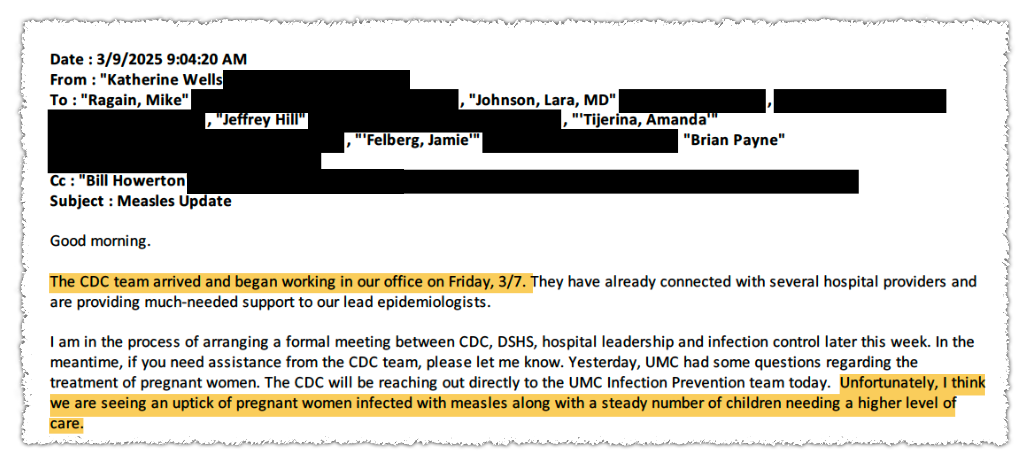
Optum Rx Invokes Open Meetings Law To Fight Kentucky Counties on Opioid Suits

UnitedHealth Group’s multibillion-dollar pharmacy benefit manager, Optum Rx, is suing five Kentucky counties in an attempt to force them out of national opioid litigation against the company.

Pharmacy benefit managers, often called PBMs, act as middlemen that negotiate prescription drug prices between drug companies, insurance plans, and pharmacies. Some lawyers and advocates say PBMs helped fuel the overdose crisis by failing to restrict the flow of opioid prescriptions.

As governments begin exploring potential lawsuits against PBMs — a step that could represent the next wave in opioid-related litigation — Optum Rx is attempting to shut down those efforts, in some cases before they even fully take shape.

In June, Optum Rx sued Anderson, Boyd, Christian, Nicholas, and Oldham counties in Kentucky for allegedly making decisions about participating in the new wave of national opioid lawsuits behind closed doors, violating Kentucky’s open meetings law. Optum Rx is asking courts to effectively force those counties to make their decisions again, this time in open meetings, potentially with the hope that some won’t bother because of the administrative burden. The result could be fewer claims against the company and possibly less money for it to pay in a future settlement.

But legal experts call Optum’s case “hypertechnical” and “frivolous,” and addiction recovery advocates say it could set a dangerous precedent for companies to evade accountability for their role in fueling the overdose crisis.

Christine Minhee, an attorney, a national expert on opioid litigation, and founder of OpioidSettlementTracker.com, said Optum’s suit reminded her of an adage among lawyers: “If the facts are on your side, pound the facts. If the law is on your side, pound the law. If neither is on your side, pound the table.”

“Right now, what we’re seeing is it pounding the table,” Minhee said of Optum Rx. The company is “desperately” trying “to find some kind of foothold” to get cases against it thrown out.

Minhee said these suits fit a pattern of Optum Rx using thin arguments to try to delay or evade opioid litigation nationwide.

Last year, Optum Rx, along with another PBM, asked a judge to throw out an opioid lawsuit filed by Los Angeles County, claiming during a December hearing that the county hadn’t shown harm. The judge appeared skeptical of the claims and ultimately rejected the companies’ request.

In April, the same companies tried to oust a federal judge overseeing national opioid litigation, claiming he was biased. Their argument was based partly on a Florida lawyer’s having said the judge was “plaintiff-oriented.” Their attempt failed.

Now, Optum Rx is working to keep five Kentucky counties out of that same sweeping opioid litigation.

That national legal undertaking began more than seven years ago, as jurisdictions saw overdose deaths climb. Many people who had become addicted to prescription painkillers were cut off by their doctors, and some transitioned to using deadlier heroin or fentanyl. Health care and public safety costs skyrocketed. Thousands of cities, counties, and states began suing health care companies for allegedly creating a public nuisance by aggressively marketing prescription painkillers and negligently distributing them.

Those cases were lassoed together into the giant multidistrict litigation, which has resulted in massive settlements. The first few waves of settlements involved opioid manufacturers, distributors, and retail pharmacies, with companies such as Johnson & Johnson, CVS, and Walgreens agreeing to pay state and local governments billions of dollars. The money is meant to be used for addiction treatment and prevention services — though its rollout has been controversial.

To add a new round of companies as defendants, jurisdictions must undertake a multistep process, said Peter Mougey, a Florida-based attorney who represents many local governments in the massive national litigation. The five Kentucky counties in question were in the early stages of that process, only having asked the judge to amend their complaint, he said. They hadn’t added Optum Rx yet.

If Optum Rx’s suits are successful, those counties would have the option of redoing the initial steps of the process in a public meeting, then continuing to add Optum Rx as a defendant, Mougey explained. The company may hope that some counties won’t undertake the extra administrative effort.

Optum Rx’s “goal is clearly just to wear down and tire out these small counties,” Mougey said. “They’re trying to have a chilling effect on the litigation.”

It’s not clear why Optum Rx targeted those five counties out of the many localities undertaking the process to add the company as a defendant. The Kentucky counties range from having fewer than 8,000 residents (Nicholas) to more than 70,000 (Christian). One is among the richest in Kentucky (Oldham), while others are poorer. Boyd County, in Appalachia, is one of the hardest hit, with a recent overdose rate twice the state average.

Optum Rx, in its filing against Boyd County, which was similar to claims against the other counties, said local authorities had taken official legal action by asking the judge to make a change in its case. The suit said such action must be done in a public meeting and that the county did not hold one.

Optum spokesperson Isaac Sorensen told KFF Health News that the company’s argument is not about “a technicality.”

It is “an important legal requirement designed to ensure accountability and transparency before a county takes legal action,” said the statement Sorensen provided. “We have found many counties ignored this requirement, alongside their duty to preserve relevant evidence, and Optum Rx will defend against these improper legal actions.”

The five Kentucky counties disagree with these assertions, according to court records. As of late July, all five had filed motions to dismiss Optum Rx’s claim.

Boyd County, like the others, argued in its motion to dismiss that asking a judge to amend its complaint was a routine, procedural step that did not require a public meeting. Optum Rx jumped the gun, the county argued, filing a case before any final action had been taken.

“No amended complaint has been filed. No new defendant, OptumRx included, has been added. No new lawsuit has been initiated,” Boyd County’s response said.

The county also pointed out that it held an open meeting in 2017 that kicked off its involvement in the national litigation and authorized future amendments to that litigation.

Hearings on the counties’ motions to dismiss Optum Rx’s suits are set for late August and early September, according to court records.

These cases are shaping up to be a Goliath-versus-David legal action. Although Oldham County is the wealthiest of the Kentucky counties that Optum Rx sued, its most recent budget is less than 0.1% of Optum Rx’s annual revenue, which the company reported as exceeding $133 billion in 2024.

Oldham County Attorney D. Berry Baxter told KFF Health News he’d seen the impact of the opioid epidemic as a prosecutor working on a growing number of drug-related cases over the years. Now, as settlement money is arriving from other companies, it has funded increased addiction treatment in local jails. More settlement money from additional companies could expand such services, Baxter said.

If Optum Rx succeeds in kicking Kentucky counties out of the national litigation, it would set “a really horrific precedent” for other PBMs and health care companies to do something similar, said Tara Hyde, CEO of the statewide nonprofit People Advocating Recovery.

Hyde said she’s been in recovery for more than a decade from an addiction that began with prescription painkillers for a broken leg. She wants to see PBMs and other companies held accountable and made to change their processes to prevent future crises.

Despite a recent decrease in overdose deaths nationwide, Hyde said people in her state, their families, and the economy are still hurting.

“Recovery doesn’t just happen overnight,” she said. “Without these dollars that have been a direct result of people being misled, mistreated, and taken advantage of, we will still be detrimentally impacted.”

KFF Health News is a national newsroom that produces in-depth journalism about health issues and is one of the core operating programs at KFF—an independent source of health policy research, polling, and journalism. Learn more about KFF.

USE OUR CONTENT

This story can be republished for free (details).
Guns, Race, and Profit: The Pain of America’s Other Epidemic

BOGALUSA, La. — Less than a mile from a century-old mill that sustained generations in this small town north of New Orleans, 19-year-old Tajdryn Forbes was shot to death near his mother’s house.

She found Forbes face down in the street in August 2023, two weeks before he had planned to move away from the empty storefronts, boarded-up houses, and poverty that make this one of the most troubled places in the nation.

Naketra Guy thought about how her son overcame losing his father at age 4 and was the glue of the family. She called him “humble” and “respectful,” a leader in the community and on the football field, where he shined.

Yet he could not outrun the grim statistics of his hometown. Bogalusa posts some of the worst health outcomes and poverty in Louisiana, a state that routinely ranks among the worst nationally in both. And Bogalusa has endured another indicator of poor public health: high levels of gun violence.

Since the beginning of the covid-19 pandemic, gun violence has shattered any sense of peace or progress here. Louisiana suffers the nation’s second-highest firearm death rate — and Bogalusa, a predominantly Black community with 10,000 residents, has seen dozens of shootings and a violent crime rate approaching twice the national average.

A nearby team refused to play football at Bogalusa High School in fall 2022, citing safety concerns.

Bogalusa’s mayor, Tyrin Truong, was elected in 2022 at age 23 on his promises to fix entrenched challenges: few youth programs and good jobs, and perpetual crime and blight.

“I ran for mayor because I got sick of seeing our city painted as mini-New Orleans,” he said, “due to the high levels of youth gun violence.”

In January, the Louisiana State Police arrested Truong, accusing him of soliciting a prostitute and participating in a drug trafficking ring that allegedly used illicit proceeds to buy firearms. He has said he is innocent. “I still haven’t been formally arraigned,” he told KFF Health News in late July, “and I haven’t been charged with anything.”

Every year tens of thousands of Americans — one every few minutes — are killed by gun violence on the scale of a public health epidemic.

Many thousands more are left to recover from severe injuries, crushing medical debt, and the mental health toll of losing loved ones.

Most headlines focus on America’s urban centers, but the numbers also reflect the growth of gun violence in places like Bogalusa, a pinprick of a town 75 miles north of New Orleans. In 2020, the gun violence death rate for rural communities was 40% higher than in large metropolitan areas, according to Johns Hopkins University.

Firearms are the No. 1 killer of children in the U.S., and no group suffers more than young Black people. More Black boys and men ages 15 to 24 in 2023 were killed in gun homicides than from the next 15 leading causes of deaths combined. Though overall U.S. homicides dropped sharply after the pandemic ended, adolescent gun deaths climbed even higher in the years after, according to research by Jonathan Jay, an associate professor in the School of Public Health at Boston University.

“It has all the markers of an epidemic. It is a major driver of death and disability,” Jay said. “Gun violence does not get the attention it deserves. It is underrecognized because it disproportionately impacts Black and brown people.”

Rather than bolstering efforts to save lives, federal, state, and local government officials have undermined them. KFF Health News undertook an examination of gun violence since the pandemic, a period when firearm death rates surged. Reporters reviewed government reports and academic research and interviewed dozens of health policy experts, activists, and victims or their relatives. They reviewed corporate earnings reports from gun manufacturers and data on the industry’s donations to politicians.

In polling published in 2023 by KFF, more than half of Americans said they or a family member had been impacted by gun violence such as by seeing a shooting or being threatened, injured, or killed with a gun.

American politicians and regulators have put in place laws and practices that have helped enrich firearm and ammunition manufacturers — which tout $91 billion in economic impact — even as gun violence has terrorized neighborhoods already damaged by white flight, systemic disinvestment, and other forms of racial discrimination.

President Donald Trump championed gun rights on the campaign trail and has received millions from the National Rifle Association, to whose members he promised, “No one will lay a finger on your firearms.” His administration has rolled back efforts under President Joe Biden to address the rise in gun violence.

Emboldened in his second term, Trump is pushing to allow more guns in schools, weaken federal oversight of the gun industry, override state and local gun laws, permit sales without background checks, and cut funding for violence intervention.

Trump ordered the attorney general to review all Biden administration actions that “purport to promote safety but may have impinged on the Second Amendment rights of law-abiding citizens.”

The Biden administration said “a historic spike in homicides” during the pandemic took its greatest toll on racially segregated and high-poverty neighborhoods.

Black youths in four major cities were 100 times as likely as white ones to experience a firearm assault, research showed. Gun suicides reached an all-time high, and for the first time the firearm suicide rate among older Black teens surpassed that of older white teens.

In Bogalusa, the pandemic gun violence spread fear. Among the victims killed were a 15-year-old attending a birthday party and a 24-year-old nationally known musician. Thirteen people were injured at a memorial for a man who himself had been shot. Residents said neighbors stopped sitting in their yards because of stray bullets.

Researchers say communities like Bogalusa endure a collective trauma that shatters their sense of safety. Two years after Forbes’ death, his mother says that when she leaves home her surviving children worry that she, too, might get shot.

Repercussions from the surge will last years, researchers said: Exposure to shootings increases risk for post-traumatic stress disorder, anxiety, suicide, depression, substance abuse, and poor school performance for survivors and those who live near them.

“We saw gun violence exposure go up for every group of children except white children, in the cities we studied,” Jay said. “Limits on government funding into gun violence research may stop us from ever knowing exactly why.”

Politics of Pain

The year before Forbes died in Bogalusa, Biden signed into law the Bipartisan Safer Communities Act, considered the most sweeping firearm legislation in decades.

In a matter of months, Trump has systematically dismantled key provisions.

Efforts to regulate guns have long proven ineffective against the power of political and business interests that fill the streets with weapons. In 2020, the number of guns manufactured annually in the U.S. hit 11.3 million, more than double a decade earlier, according to the federal government. In 2022, the United States had nearly 78,000 licensed gun dealers, more than its combined number of McDonald’s, Burger King, Wendy’s, and Subway locations, according to Everytown for Gun Safety, an advocacy group.

The Biden administration announced in 2021 it would attempt to reduce gun violence by adopting a “zero tolerance” policy toward firearm dealers who committed violations such as failing to run a required background check or selling to someone prohibited from buying a gun.

The federal Bureau of Alcohol, Tobacco, Firearms and Explosives, or ATF, which licenses gun dealers, has the authority to enforce laws meant to prevent illegal gun sales. In issuing an executive order, the Trump administration declared that, under Biden, the agency targeted “mom-and-pop shop small businesses who made innocent paperwork errors.”

From October 2010 to February 2022, the agency conducted more than 111,000 inspections, recommending revocation of a dealer’s license only 589 times, about 0.5% of cases, an inspector general’s report said. Even when it cited serious violations, the ATF rarely shut dealers down.

ATF leaders told the inspector general’s office that recommendations for license revocations increased after Biden’s zero-tolerance policy was implemented. In April, the Trump administration repealed it.

Surgeon General Vivek Murthy last year declared firearm violence a public health crisis. Within weeks of Trump’s inauguration, his administration removed the advisory. Of the 15 leading U.S. causes of death, firearm injuries received less research funding from the National Institutes of Health for each person who died than all but poisoning and falls, according to an analysis in 2024 by Brady, an anti-gun violence organization. Trump is trying to cut that funding, too.

Trump’s Department of Justice abruptly cut 373 grants in April for projects worth about $820 million, with a large share from gun violence intervention.

“We are going to lose a generation of community violence prevention folks,” said Volkan Topalli, a gun violence researcher at Georgia State University. “People are going to die, I’m sorry to say, but that is the bleak truth of this.”

Asked about its policies, the White House did not address questions about public health considerations around gun violence.

“Illegal violence of any sort is a crime issue, and President Trump has been clear since Day One that he is committed to Making America Safe Again by empowering law enforcement to uphold law and order,” White House spokesperson Kush Desai said.

Trump administration officials “want safer streets and less violence,” Topalli said. “They are hurting their cause.”

Garen Wintemute, an emergency medicine professor who directs the violence prevention program at the University of California-Davis, was among the first in the nation to consider guns and violence as a public health issue. He said race plays a significant role in perceptions about gun violence.

“People look at the demographic risk for firearm homicide and depending on the demographics of the people in the audience, I can see the transformation in their faces,” Wintemute said. “It’s like they’re saying, ‘Not my people, not my problem.’”

Eroding Gun Restrictions

Trump’s incursions against public health efforts to contain gun violence are backed by lobbying power.

Firearm industry advocacy groups made millions of dollars in political donations in recent years, mostly to conservative causes and Republican candidates. That includes $1.4 million to Trump, according to OpenSecrets, which tracks campaign finance data.

The assassination of civil rights icon the Rev. Martin Luther King Jr. helped lead to the passage of the federal Gun Control Act of 1968, which imposed stricter licensing rules and outlawed the sale of firearms and ammunition to felons.

While it remains the law of the land, over time, federal and state government actions have significantly weakened its protections.

Most states now allow people to carry concealed weapons without a permit or background check, even though research suggests the practice can increase the risk of firearm homicides.

In Louisiana, Democratic former Gov. John Bel Edwards, in office from 2016 to 2024, vetoed a bill that would have allowed people to carry concealed firearms without a permit.

Elected in 2023, Republican Gov. Jeff Landry signed a law to allow any person over age 18 to conceal-carry without a permit.

The Trump administration has created a task force to implement his executive order to end most gun regulations and which would allow more people with criminal convictions, including for domestic abuse, to own guns.

Figures vary, but some researchers estimate as many as 500 million guns circulate in the U.S. Sales reached record highs during the pandemic and publicly traded firearm and ammunition companies saw profits jump.

Donald Trump Jr. this summer joined the board of GrabAGun, an online gun retailer that went public in July under the stock ticker PEW. In a Securities and Exchange Commission filing, the company, which markets guns to people ages 18 to 44, cited “gun violence prevention and legislative advocacy organizations that oppose sales of firearms and ammunition” as threats to its sales growth.

Dave Workman, a gun rights advocate with the Second Amendment Foundation, said firearms are not to blame for the surge in pandemic shootings.

“Bad guys are going to do what bad guys are going to do regardless of the law,” Workman said. “Taking away gun rights is not going to reduce crime.”

David Yamane, a Wake Forest University sociology professor and national authority on guns, said the U.S. firearm debate is complex and the industry is often “painted with too broad a brush.”

Most guns will never be used to kill anyone, he said. Americans tend to buy more guns during times of unrest, Yamane added: “It’s part of the American tradition. Guns are seen as a legitimate tool for defending yourself.”

‘A Low Level of Hope’

Once called “the Magic City,” Bogalusa has become a grim symbol of deindustrialization.

Bogalusa emerged as Black people formed their own communities in the time of Jim Crow racial segregation at the turn of the 20th century.

Racism concentrated Black people in neighborhoods that became epicenters of poor health, reflected in high rates of cancer, asthma, chronic stress, preterm births, pregnancy-related complications — and, over recent decades, firearm violence.

Thousands flocked to Bogalusa after the Great Southern Lumber Company built one of the world’s biggest sawmills, establishing Bogalusa as a company town. Racial tensions soon followed.

Members of the local Deacons for Defense and Justice gained national attention in the 1960s for protecting civil rights organizers from the Ku Klux Klan, a hate group that burned houses and churches, terrorizing and killing Black people.

As the mill changed hands over the decades, Bogalusa’s fortunes slid. In the mid-20th century, the population surpassed 20,000, but it is now about half that.

International Paper, a Fortune 500 company based in Tennessee, runs the mill as a containerboard factory, employing about 650 people. In 2021, the state announced incentives for the company that included a $500,000 tax break, saying the move would help bring “prosperity.”

Businesses remain boarded up along the main drag. Houses still bear damage from Hurricane Katrina, and many streets are eerily quiet.

Nearly 1 in 3 people in Bogalusa live in poverty — 2½ times the national average.

Bogalusa’s violent gun crime rate reached 646.1 per 100,000 people in 2022, higher than Louisiana’s and 1.7 times the national one, according to the nonprofit Equal Justice USA, citing FBI Uniform Crime Reporting data.

In many rural towns across the South, “there is a level of desperation that is more apparent” than in other parts of the U.S., said Luke Shaefer, a University of Michigan professor of social justice and public policy.

“They don’t have the same infrastructure to have robust social services. People are like, ‘What are my life chances?’” Shaefer said. “People feel like there is nothing that can be done. There is a low level of hope.”

Missed Opportunities

Mayor Truong lamented the violence in Bogalusa after Forbes was killed, writing on Facebook, “When are we as a community going to come together and decide enough is enough?”

The federal government had offered one path forward.

The Biden administration provided billions of dollars to local governments through the American Rescue Plan Act during the pandemic. Biden urged them to deploy money to community violence intervention programs, shown to reduce homicides by as much as 60%.

A handful of cities seized the opportunity, but most did not. Bogalusa has received $4.25 million in ARPA funds since 2021. None appears to have gone toward violence prevention.

The Louisiana legislative auditor, Michael Waguespack, found that Bogalusa used nearly $500,000 for employee bonuses, which his report said may have violated state law. In some cases, the report says, payments were not tied to work performed.

Bogalusa officials did not respond to a public records request from KFF Health News seeking detailed information about its ARPA money.

Former Mayor Wendy O’Quin-Perrette, who served from 2015 through early 2023, told Waguespack in a June 2024 letter that the city used ARPA money to improve streets and pay the bonuses. “We would not have done it without being sure it was allowed,” she said.

O’Quin-Perrette did not respond to requests for comment.

In a 2023 letter to Waguespack, O’Quin-Perrette’s successor, Truong, wrote that Bogalusa officials didn’t know how the federal money was spent. When he took office, Truong alleged, officials discovered “tens of thousands of dollars of checks and cash” stashed “in various drawers and on desks” in city offices.

Truong defended his stewardship of ARPA funds, saying that about $1 million remained when he assumed office but that the money was needed for more urgent sewer infrastructure repairs. “I wish we could have invested more, invested any money in gun violence prevention efforts,” he said.

In an interview, Truong said the city has been “intentional” about bringing down gun violence, including through a summer jobs program. He pointed to statistics that show homicides decreased from nine in 2022 to two in 2024. “If you keep them busy, they won’t have time to do anything else,” he said.

Asked about his January arrest, Truong said he has political enemies.

“I’m the only Democrat in a very red part of the state, and, you know, I’ve made a lot of changes at City Hall, and that ticks people off,” Truong told KFF Health News. He said that he ended long-standing city contracts with local businesspeople. “When you’re shaking up power structures, you become a target.”

Josie Alexander, a Louisiana-based senior strategist for Equal Justice USA, said city officials missed an opportunity when they didn’t use ARPA funds for gun violence prevention. “The sad thing is people here can now see that money was coming in,” she said. “But it just wasn’t used the way it needed to be.”

‘Too Much Trouble Here’

Truong said the city is still reeling from the pandemic spike in violent crime. He said he was at Bogalusa High School’s homecoming football game in 2022 when one teen shot another. Shots rang out, Truong said, and he grabbed his 3-month-old son and “laid in the bleachers.”

“It’s not a foreign topic to hardly anybody in town, whether you’ve heard the gunshots in the distance, whether you have attended a funeral of somebody who passed due to gun violence,” he said. Many still grapple with trauma.

In December 2022, Khlilia Daniels said, she hosted a birthday party for her teenage niece, praying no one would bring a gun.

The hosts checked guests for weapons, she said.

Yet gunfire erupted, Daniels said. Three teens were shot, including 15-year-old Ronié Taylor, who died, according to police.

“When someone you know is killed, you never forget,” said Daniels, 32, who held Taylor until emergency responders arrived.

Tajdryn Forbes was planning his future when he was killed, likely because of a dispute that started on social media over lyrics in a rap song, Guy said.

In a Facebook post in January, Bogalusa police said they had arrested someone in connection with Forbes’ killing. Authorities had previously announced the arrest of a teen in connection with the homicide.

Forbes had been a high school football standout, like his late father, Charles Forbes Jr., who played semipro. When Forbes scored a touchdown, he would look to the sky to honor his dad.

The school praised Forbes for his senior baseball season in a social media post: “This young man makes a difference on our campus and on the field with his strong character.”

When hopes for a college football scholarship did not pan out, Forbes worked as a deckhand for a marine transportation company. He saved money, looking forward to moving to Slidell, a suburb of New Orleans.

“He would always say, ‘There’s too much trouble here’” in Bogalusa, Guy recalled.

KFF Health News is a national newsroom that produces in-depth journalism about health issues and is one of the core operating programs at KFF—an independent source of health policy research, polling, and journalism. Learn more about KFF.

USE OUR CONTENT

This story can be republished for free (details).