What the Health? From KFF Health News: Time’s Up for Expanded ACA Tax Credits

The Host

Julie Rovner
KFF Health News


@jrovner


@julierovner.bsky.social


Read Julie’s stories.

Julie Rovner is chief Washington correspondent and host of KFF Health News’ weekly health policy news podcast, “What the Health?” A noted expert on health policy issues, Julie is the author of the critically praised reference book “Health Care Politics and Policy A to Z,” now in its third edition.

The enhanced premium tax credits that since 2021 have helped millions of Americans pay for insurance on the Affordable Care Act marketplaces will expire Dec. 31, despite a last-ditch effort by Democrats and some moderate Republicans in the House of Representatives to force a vote to continue them. That vote will happen, but not until Congress returns in January.

Meanwhile, the Department of Health and Human Services canceled a series of grants worth several million dollars to the American Academy of Pediatrics after the group again protested HHS Secretary Robert F. Kennedy Jr.’s changes to federal vaccine policy.

This week’s panelists are Julie Rovner of KFF Health News, Lizzy Lawrence of Stat, Tami Luhby of CNN, and Alice Miranda Ollstein of Politico.

Panelists

Lizzy Lawrence
STAT News


@LizzyLaw_


@lizzylawrence.bsky.social


Ready Lizzy’s stories.

Tami Luhby
CNN


@Luhby


Read Tami’s stories.

Alice Miranda Ollstein
Politico


@AliceOllstein


@alicemiranda.bsky.social


Read Alice’s stories.

Among the takeaways from this week’s episode:

  • The House on Wednesday passed legislation containing several GOP health priorities, including policies that expand access to association health plans and lower the federal share of some Affordable Care Act exchange marketplace premiums. It did not include an extension of the expiring enhanced ACA premium tax credits — although, also on Wednesday, four Republicans signed onto a Democratic-led discharge petition forcing Congress to revisit the tax credit issue in January.
  • In vaccine news, the American Academy of Pediatrics spoke out against the federal government’s recommendation of “individual decision-making” when it comes to administering the hepatitis B vaccine to newborns — and HHS then terminated multiple research grants to the AAP. Meanwhile, the Centers for Disease Control and Prevention is funding a Danish study of the hepatitis B vaccine in West Africa through which some infants will not receive a birth dose, a strategy that critics are panning as unethical.
  • Also, a second round of personnel cuts at the Department of Veterans Affairs is expected to exacerbate an existing staffing shortage and further undermine care for retired service members.
  • The FDA is considering rolling back labeling requirements on supplements — a “Make America Health Again”-favored industry that is already lightly regulated.
  • And abortion opponents are pushing for the Environmental Protection Agency to add mifepristone to the list of dangerous chemicals the agency tracks in the nation’s water supply.

Also this week, Rovner interviews Tony Leys, who wrote the latest “Bill of the Month” feature, about an uninsured toddler’s expensive ambulance ride between hospitals.

Plus, for a special year-end “extra-credit” segment, the panelists suggest what they consider 2025’s biggest health policy themes:

Julie Rovner: The future of the workforce in biomedical research and health care.

Lizzy Lawrence: The politicization of science.

Tami Luhby: The systemic impacts of cuts to the Medicaid program.

Alice Miranda Ollstein: The resurgence of infectious diseases.

Also mentioned in this week’s podcast:

Credits

Taylor Cook
Audio producer

Emmarie Huetteman
Editor

Click here to find all our podcasts.

And subscribe to “What the Health? From KFF Health News” on Apple Podcasts, Spotify, the NPR app, YouTube, Pocket Casts, or wherever you listen to podcasts.

KFF Health News is a national newsroom that produces in-depth journalism about health issues and is one of the core operating programs at KFF—an independent source of health policy research, polling, and journalism. Learn more about KFF.

USE OUR CONTENT

This story can be republished for free (details).

Worried About Health Insurance Costs? There May Be Cheaper Options — But With Trade-Offs

For the millions of Americans who buy Affordable Care Act insurance, there’s still time left to enroll for 2026. But premium increases and the expiration of enhanced tax subsidies have led to larger-than-expected costs.

Concerned shoppers, wondering if there’s anything they can do, are consulting insurance brokers or talking to representatives at ACA marketplace call centers.

“We’re hearing from people with complex medical conditions who don’t think they can survive if they don’t have access to medical care,” said Audrey Morse Gasteier, executive director of the Massachusetts Health Connector, that state’s insurance marketplace.

And some are considering going outside the ACA to find more affordable options. But that requires caution.

Congress looks increasingly unlikely to extend the enhanced subsidies before the year’s end. Late Wednesday, the House passed a package of measures favored by conservatives that does not address the subsidies and is largely viewed as dead on arrival in the Senate. Earlier Wednesday, however, four GOP moderates joined with Democrats to sign a discharge petition to force a vote — likely in January — on a three-year extension. The Senate and President Donald Trump would also have to approve the measure, but if extended the subsidies could be applied retroactively.

Meanwhile, the deadline for choosing a health plan is quickly approaching. The official end of open enrollment is set for Jan. 15 for coverage starting Feb. 1. In most states, it’s already too late to enroll for coverage starting Jan. 1.

Here are five considerations in the decision-making process:

1. Short-Term Plans: ‘You Have To Be Healthy’

Some ACA shoppers might find themselves considering short-term insurance plans sold outside the government-run marketplaces — or steered toward the plans by insurance brokers. Be wary.

Short-term plans are just that: insurance originally designed as temporary coverage for situations like changing jobs or attending school. They can look a lot like traditional coverage, with deductibles, copayments, and participating networks of hospitals and doctors. Still, they are not ACA-compliant plans and are not available on the official ACA marketplaces.

They are often less expensive than ACA plans. But they cover less. For example, unlike ACA plans, they can impose annual and lifetime caps on benefits. The vast majority do not cover maternity care. Some might not cover prescription drugs.

Short-term plans require applicants to complete a medical questionnaire, and insurers can exclude coverage or cancel a policy retroactively for those with preexisting medical conditions. Also, depending on the terms of the particular plan, a person who develops a medical condition during the coverage period might not be accepted for renewal.

In addition, short-term plans are not required to cover care on the ACA’s checklist of essential benefits, such as preventive care, hospitalization, or emergency services.

The shortcomings of the plans, which critics say are sometimes marketed in misleading ways, have led Democrats to label them “junk insurance.” The Trump administration argues they’re suitable for some people and has sought to make them more widely available.

“We recommend it when it makes sense,” said Joshua Brooker, a Pennsylvania insurance broker. “But if you’re going to enroll in short-term coverage, you need to know which boxes are unchecked.”

“They’re not for everyone. You have to be healthy,” said Ronnell Nolan, the president and CEO of Health Agents of America, a trade group.

And they’re available in only 36 states, according to KFF, a health information nonprofit that includes KFF Health News. Some states, such as California, prohibit them. Others set tight restrictions.

2. Beware of Coverage That’s Not Comprehensive

There are other types of health coverage offered by sales brokers or other organizations.

One kind, called an indemnity plan, is meant to supplement a traditional health insurance plan by paying toward deductibles or copayments.

Those plans do not have to follow ACA coverage rules, either. Generally, they pay a fixed dollar amount — say a few hundred dollars a day — toward a hospital stay or a smaller amount for a doctor’s office visit. Typically those payments fall short of the full costs and the policyholder pays the rest. They generally also require consumers to fill out medical forms stating any preexisting conditions.

Another type, a faith-based sharing plan, pools money from members to cover their medical bills. The plans are not required to keep any specific amount of financial reserves and members are not guaranteed that the plans will pay their health expenses, according to the Commonwealth Fund, a foundation that supports health care research and improvements to the health system.

Sharing plans expanded beyond faith communities after the ACA was adopted. Like short-term plans, they cost less than ACA plans but also don’t have to follow ACA rules.

They are not considered insurance, and some have been accused of fraud by state regulators.

“Yes, it is cheaper, and yes, it does work for some people,” Nolan said. “But you need to understand what that plan does. It would be my last resort.”

3. Consider a ‘Bronze’ or ‘Catastrophic’ Plan, But Be Aware of Deductibles

For those wanting to stay with ACA plans, the lowest premiums are generally in the categories labeled “catastrophic” or “bronze.”

Jessica Altman, executive director of California’s ACA exchange, said her state has noticed an uptick in enrollments in bronze-level plans. They have lower premiums but high annual deductibles — the amount a customer must spend before most coverage kicks in. Deductibles for bronze plans average nearly $7,500 nationally, according to KFF.

Another option, new for 2026, is expanded eligibility for catastrophic plans, which used to be limited to people younger than age 30. As the name suggests, they’re intended for people who want health insurance just in case they suffer a catastrophic health condition, such as cancer or injuries from a car accident, and the plans can have deductibles as high as the ACA’s annual limit on out-of-pocket spending — $10,600 for an individual or $21,200 for a family.

But now people losing subsidies because of the expiration of the enhanced tax credits can also qualify for the plans. However, they may not be available in every region.

Lauren Jenkins, a broker in Oklahoma, said some of her clients earning less than $25,000 this year had qualified for very low-cost or free plans with the enhanced subsidies. Next year, though, their costs may rise to $100 or more per month for a “silver”-level plan, a step up from bronze.

So she is showing them bronze plans to bring down the monthly cost. “But they might have a $6,000, $7,000, or $10,000 deductible they now have to pay,” Jenkins said. “For people only making $25,000 a year, that would be detrimental.”

Both bronze and catastrophic plans are eligible to be linked with health savings accounts, which can be used to save money tax-free for medical expenses. They are more popular with higher-income households.

4. Another Plan May Have Lower Premiums

It can pay to shop around. Some people may be able to find a lower premium by shifting to a different plan, even one offered by the same insurer. There are also different levels of coverage, from bronze to “platinum,” where premiums also vary. Brooker said that in some locations “gold”-level plans are less expensive than silver, even though that seems counterintuitive.

Also, some people who run their own businesses but have only one employee might qualify for a group plan rather than an individual policy. Sometimes those can be less expensive.

Not every state allows this, Nolan said. But, for example, Nolan said, she has a client whose only employee is his wife, so she’s going to see whether they can get a group plan at lower rates.

“That might work out for them,” she said.

ACA rates for small group plans (fewer than 50 employees) vary regionally and are not always less expensive than individual coverage, Brooker said.

“It’s pretty all over the board as to where the rates are better,” he said.

5. Other Rules of the Road

Insurance experts encourage people not to wait until the last minute to at least take preliminary steps. Shoppers can go onto the official federal or state marketplace website and fill out or update an application with required income and other information necessary to determine what the 2026 plan year holds for them.

For instance, even without congressional intervention, subsidies will not go away entirely. They will be smaller, though, and there is an upper income limit — a cutoff for households earning more than four times the poverty level, which comes to $62,600 for an individual and $84,600 for a couple for 2026.

When shopping, consumers should make sure they land on an official ACA website, because there are look-alikes that may not offer ACA-compliant plans. Healthcare.gov is the official federal site. From there, people can find websites serving the 20 states, along with the District of Columbia, that run their own ACA exchanges.

The government sites can also direct consumers to licensed brokers and other counselors who can help with an application.

And a reminder: Consumers also need to pay their first month’s premium for coverage to take effect.

KFF Health News is a national newsroom that produces in-depth journalism about health issues and is one of the core operating programs at KFF—an independent source of health policy research, polling, and journalism. Learn more about KFF.

USE OUR CONTENT

This story can be republished for free (details).

Oregon Hospital Races To Build a Tsunami Shelter as FEMA Fights To Cut Its Funding

ASTORIA, Ore. — Residents of this small coastal city in the Pacific Northwest know what to do when there’s a tsunami warning: Flee to higher ground.

For those in or near Columbia Memorial, the city’s only hospital, there will soon be a different plan: Shelter in place. The hospital is building a new facility next door with an on-site tsunami shelter — an elevated refuge atop columns deeply anchored in the ground, where nearly 2,000 people can safely wait out a flood.

Oregon needs more shelters like the one that Columbia Memorial is building, emergency managers say. Hospitals in the region are likely to incur serious damage, if not ruin, and could take more than three years to fully recover in the event of a major earthquake and tsunami, according to a state report.

Columbia Memorial’s current facility is a single-story building, made of wood a half-century ago, that would likely collapse and sink into the ground or be swallowed by a landslide after a major earthquake or a tsunami, said Erik Thorsen, the hospital’s chief executive.

“It is just not built to survive either one of those natural disaster events,” Thorsen said.

At least 10 other hospitals along the Oregon coast are in danger as well. So Columbia Memorial leaders proposed building a hospital capable of withstanding an earthquake and landslide, with a tsunami shelter, instead of relocating the facility to higher ground. Residents and state officials supported the plans, and the federal government awarded a $14 million grant from the Federal Emergency Management Agency to help pay for the tsunami shelter.

The project broke ground in October 2024. Within six months, the Trump administration had canceled the grant program, known as Building Resilient Infrastructure and Communities, or BRIC, calling it “yet another example of a wasteful and ineffective FEMA program … more concerned with political agendas than helping Americans affected by natural disasters.”

Molly Wing, director of the expansion project, said losing the BRIC grant felt like “a punch to the gut.”

“We really didn’t see that coming,” she said.

This summer, Oregon and 19 other states sued to restore the FEMA grants. On Dec. 11, a judge ruled that the Trump administration had unlawfully ended the program without congressional approval.

The administration did not immediately indicate it would appeal the decision, but Department of Homeland Security spokesperson Tricia McLaughlin said by email: “DHS has not terminated BRIC. Any suggestion to the contrary is a lie. The Biden Administration abandoned true mitigation and used BRIC as a green new deal slush fund. It’s unfortunate that an activist judge either didn’t understand that or didn’t care.” FEMA is a subdivision of DHS.

Columbia Memorial was one of the few hospitals slated to receive grants from the BRIC program, which had announced more than $4.5 billion for nearly 2,000 building projects since 2022.

Hospital leaders have decided to keep building — with uncertain funding — because they say waiting is too dangerous. With the Trump administration reversing course on BRIC, fewer communities will receive help from FEMA to reduce their disaster risk, even places where catastrophes are likely.

More than three centuries have passed since a major earthquake caused the Pacific Northwest’s coastline to drop several feet and unleashed a tsunami that crashed onto the land in January 1700, according to scientists who study the evolution of the Oregon coast.

The greatest danger is an underwater fault line known as the Cascadia Subduction Zone, which lies 70 to 100 miles off the coast, from Northern California to British Columbia.

The Cascadia zone can produce a megathrust earthquake, with a magnitude of 9 or higher — the type capable of triggering a catastrophic tsunami — every 500 years, according to the U.S. Geological Survey. Scientists predict a 10% to 15% chance of such an earthquake along the fault zone in the next 50 years.

“We can’t wait any longer,” Thorsen said. “The risk is high.”

Building for the Future

The BRIC program started in 2020, during the first Trump administration, to provide communities and institutions with funding and technical assistance to fortify their structures against natural disasters.

Joel Scata, a senior attorney with the environmental advocacy group Natural Resources Defense Council, said the program helped communities better prepare so they could reduce the cost of rebuilding after a flood, tornado, wildfire, or extreme weather event.

To qualify for a grant, a hospital had to show that the project’s benefits were greater than the future danger and cost. In some cases, that benefit might not be readily apparent.

“It prevents bad disasters from happening, and so you don’t necessarily see it in action,” Scata said.

Scata noted that the Trump administration has also stopped awarding grants through FEMA’s Hazard Mitigation Grant Program, which predates BRIC.

“There really is no money going out the door from the federal government to help communities reduce their disaster risk,” he said.

A recent KFF Health News investigation using proprietary data from Fathom, a global leader in flood modeling, found that at least 170 U.S. hospitals are at risk of significant and potentially dangerous flooding from more intense and frequent storms. That count did not include Columbia Memorial, as Fathom’s data did not account for tsunamis. It models flooding from rivers, sea level rise, and extreme rainfall.

In recent days, an atmospheric river — a narrow storm band carrying significant amounts of moisture — dumped more than 15 inches of rain on parts of Oregon and Washington, causing catastrophic flooding along rivers and the coast. In the Washington town of Sedro-Woolley, which sits along the Skagit River, the PeaceHealth United General Medical Center evacuated nonemergency patients.

High winds battered Astoria, leaving the city with some minor landslides, according to news reports. But flooding on the road to the nearby beach town of Seaside made the drive nearly impassable.

The Trump administration is leaning on states to take greater responsibility for recovering from natural disasters, Scata said, but most states are not financially prepared to do so.

“The disasters are just going to keep on piling up,” he said, “and the federal government’s going to have to keep stepping in.”

A Hospital at Risk

Columbia Memorial is blocks from the southern shore of the Columbia River, near the Washington border, where the area’s natural hazards include earthquakes, tsunamis, landslides, and floods. A critical access hospital with 25 beds, it opened in 1977 — before state building codes addressed tsunami protections.

Thorsen said the new facility and shelter would be a “model design” for other hospitals. Design plans show a five-level hospital built atop a foundation anchored to the bedrock and surrounded by concrete columns to shield it from tsunami debris.

The shelter will be on the roof of the second floor, above the projected maximum tsunami inundation. It will be accessible via an outdoor staircase and interior staircases and elevators, with enough room for up to 1,900 people, plus food, water, tents, and other supplies to sustain them for five days.

With most patient care provided on the second and third levels, generators on the fourth level, and utility lines underground, the hospital is expected to remain operational after a natural disaster.

Thorsen said an earthquake and tsunami threaten not only vast flooding but also liquefaction, in which the ground loosens and causes structures above it to collapse. Deep foundations, thick slabs, and other structural supports are expected to protect the new hospital and tsunami structure against such failure.

Through the years, hospital administrators and civic leaders in Astoria have sought other locations for Columbia Memorial. But relocation wasn’t economical. Columbia Memorial committed to invest in a new hospital and tsunami shelter to protect not only patients and staff but also nearby residents.

“Your community should count on your hospital to be a safe haven in a natural disaster,” Thorsen said.

Fighting To Restore Funds

The estimated construction budget for Columbia Memorial’s expansion is $300 million, mostly financed through new debt from the hospital. The tsunami shelter is budgeted at about $20 million, for which FEMA’s BRIC program awarded nearly $14 million, with a $6 million matching grant from the state, which has maintained its support.

The shelter and the building’s structural protections — featuring reinforced steel, deeper foundations, and thicker slabs — are integral to the design and cannot be removed without compromising the rest of the structure, said Michelle Checkis, the project architect.

“We can’t pull the TVERS [tsunami vertical evacuation refuge structure] out without pulling the hospital back apart again,” she said. “It’s kind of like, if I was going to stack it up with Legos, I would have to take all those Legos apart and stack it up completely differently.”

Columbia Memorial has sought help from Oregon’s congressional delegation. In a letter to Department of Homeland Security Secretary Kristi Noem and former FEMA acting administrator David Richardson, the lawmakers demanded that the agencies restore the hospital’s grant.

The hospital’s leadership is seeking other grants and philanthropic donations to make up for the loss. As a last resort, Thorsen said, the board will consider removing “nonessential features” from the building, though he added that there is little fat to trim from the project.

The lawsuit brought by states in July alleged that FEMA lacks the authority to cancel the BRIC program or redirect its funding for other purposes.

The states argued that canceling the program ran counter to Congress’ intent and undermined projects underway.

In their response to the lawsuit, the Trump administration said repeatedly that the defendants “deny that the BRIC program has been terminated.”

The lawsuit cites examples of projects at risk in each state due to FEMA’s termination of the grants. Oregon’s first example is Columbia Memorial’s tsunami shelter. “Neither the County nor the State can afford to resume the project without federal funding,” the lawsuit states.

In response to questions about the impact of canceling the grant on Astoria and the surrounding community, DHS spokesperson Tricia McLaughlin said BRIC had “deviated from its statutory intent.”

“BRIC was more focused on climate change initiatives like bicycle lanes, shaded bus stops, and planting trees, rather than disaster relief or mitigation,” McLaughlin said. DHS and FEMA provided no further comment about BRIC or the Astoria hospital.

Preparing for a Tsunami Disaster

Located near the end of the Lewis & Clark National Historic Trail, Astoria sits on a peninsula that juts into the Columbia River near the Pacific Ocean.

Much of the city is not in the tsunami inundation area. But Astoria’s downtown commercial district — where gift shops, hotels, and seafood restaurants line the streets — is nearly all an evacuation zone.

Two hospitals — Ocean Beach Health in nearby Washington, and Providence Seaside Hospital in Oregon — are about 20 miles from Columbia Memorial. Both are 25-bed hospitals, and neither is designed to withstand a tsunami.

Ocean Beach Health regularly conducts drills for mass-casualty and natural disasters, said Brenda Sharkey, its chief nursing officer.

“We focus our planning and investments on areas where we can make a real difference for our community before, during, and after an event — such as maintaining continuity of care, ensuring rapid triage, and coordinating with regional emergency partners,” Sharkey said in an email.

Gary Walker, a spokesperson for Providence Seaside, said in a statement that the hospital has a “comprehensive emergency plan for earthquakes and tsunamis, including alternative sites and mobile resources.”

Walker added that Providence Seaside has hired “a team of consultants and experts to conduct a conceptual resilience study” that would evaluate the hospital’s vulnerabilities and recommend ways to address them.

Oregon’s emergency managers advise residents and visitors in coastal communities to immediately seek higher ground after a major earthquake — and not to rely on tsunami sirens, social media, or most technology.

“There may not even be cellphone towers operating after an event like this,” said Jonathan Allan, a coastal geomorphologist with the Oregon Department of Geology and Mineral Industries. “The earthquake shaking, its intensity, and particularly the length of time in which the shaking persists, is the warning message.”

The stronger the earthquake and the longer the shaking, he said, the more likely a tsunami will head to shore.

A tsunami triggered by a Cascadia zone earthquake could strike land in less than 30 minutes, according to state estimates.

Many of Oregon’s seaside communities are near high-enough ground to seek safety from a tsunami in a relatively short time, Allan said. But he estimated that, to save lives, Oregon would need about a dozen vertical tsunami evacuation shelters along the coast, including in seaside towns that attract tourists and where the nearest high ground is a mile or more away.

Willis Van Dusen’s family has lived in Astoria since the mid-19th century. A former mayor of Astoria, Van Dusen stressed that tsunamis are not a hypothetical danger. He recalled seeing one in Seaside in 1964. The wave was only about 18 inches high, he said, but it flooded a road and destroyed a bridge and some homes. The memory has stayed with him.

“It’s not like … ‘Oh, that’ll never happen,’” he said. “We have to be prepared for it.”

KFF Health News correspondent Brett Kelman contributed to this report.

KFF Health News is a national newsroom that produces in-depth journalism about health issues and is one of the core operating programs at KFF—an independent source of health policy research, polling, and journalism. Learn more about KFF.

USE OUR CONTENT

This story can be republished for free (details).

In the Vast Expanses of Indian Country, Broadband Gaps Create Health Gaps, Too

FORT HALL RESERVATION, Idaho — Standing atop Ferry Butte, Frances Goli scanned the more than half a million acres of Shoshone-Bannock tribal land below as she dug her hands into the pockets of a pink pullover.

The April wind was chilly at one of the tribes’ highest vistas in remote southeastern Idaho.

“Our goal is to bring fiber out here,” Goli said, sweeping one hand across the horizon. The landscape below is scattered with homes, bordered in the east by snowcapped mountain peaks and to the west by “The Bottoms,” where tribal bison graze along the Snake River.

In between, on any given day, a cancer patient drives to the reservation’s casino to call doctors. A young mother asks one child not to play video games so another can do homework. Tribal field nurses update charts in paper notebooks at patients’ homes, then drive back to the clinic to pull up records, send orders, or check prescriptions.

Three years ago, the Shoshone-Bannock Tribes were awarded more than $22 million during the first round of the federal Tribal Broadband Connectivity Program. But tribes that were awarded millions in a second round of funding saw their payments held up under the Trump administration. Last month, federal leaders announced modifications to tribal broadband programs as part of a larger effort to “reduce red tape.” The National Telecommunications and Information Administration said it plans to “promote flexibility” and launch a new grant in the spring.

Federal regulators declined to provide details. The announcement comes after a year of upheaval for federal broadband programs, including the elimination of Digital Equity Act funding, which President Donald Trump has called “racist,” and a restructured $42 billion Broadband, Equity, Access, and Deployment program, which U.S. Commerce Secretary Howard Lutnick said was influenced by “woke mandates.”

Across Indian Country and on the Fort Hall Reservation, high-speed internet service gaps persist despite billions set aside for tribes. In early November, U.S. Sens. Maria Cantwell (D-Wash.) and Brian Schatz (D-Hawaii) asked federal agency leaders why funds already awarded had not been released to tribes and whether federal regulators were providing adequate technical assistance.

So far, the $3 billion tribal program has announced $2.24 billion in awards for 275 projects nationwide. But tribes that won awards have drawn down only about $500 million, according to a recent update from the Commerce Department’s Office of Inspector General.

The agency has initiated tribal consultation on the broadband programs, offering tribal leaders two dates in January for online meetings.

The Shoshone-Bannock Tribes have drawn down less than 2% of their awarded funding and the program has not yet connected a single household, Goli said. NTIA spokesperson Stephen Yusko said the Shoshone-Bannock Tribes are still slated to get their full grant award and, he confirmed, future spending will not be subject to the administration’s recalibrations.

Gaps in high-speed internet can be profound and urgent on tribal lands. Tribal members are historically underserved and, on average, live with the highest rates of chronic illnesses and die 6.5 years earlier than the average U.S. resident.

Diabetes and high suicide rates are among the most pernicious tribal health challenges — and federal research confirms telehealth can improve health outcomes. A KFF Health News analysis showed that people tend to live sicker and die younger in America when they live in dead zones, or places where poor internet access intersects with shortages of health care providers, leaving patients who need it most unable to use telehealth.

“We’re in survival mode,” said Nancy Eschief Murillo, a longtime Shoshone-Bannock leader. The tribes, which have an on-site clinic, need more health care both in person and with telehealth, she said. “Right now, our reservation? We don’t have accessibility.”

‘Not 100% Accurate’

Inside a trailer that serves as the temporary headquarters for Fort Hall’s tribal broadband office, Goli sat at a desk in June and scanned the Federal Communications Commission’s most recent online map of the reservation.

As the tribes’ broadband project manager, Goli didn’t like what she saw on the map. Blue hexagons highlighted varying rates of high-speed coverage and signified that high-speed internet is available on much of the reservation. Companies have told federal regulators they provide fast transmission speeds to homes there.

“These are untrue,” Goli said. Fort Hall has about 2,400 households, and nearly all of them live without high-speed internet, she said.

When it comes to tracking who on a reservation has high-speed internet, “everybody acknowledges, including the FCC, that the map is not 100% accurate,” said Robert Griffin, co-chair of the Fiber Broadband Association Tribal Committee, an industry trade group. He is also the broadband director for the Choctaw Nation of Oklahoma.

Attempting to correct the maps is one of the many tasks Goli has taken on since becoming the Shoshone-Bannock Tribes’ broadband project manager in January 2023 — seven months after the tribes won the award.

A series of hurdles, including flaws in the plan initially approved by the federal government and a cyberattack, have delayed the project, she said. The attack hit in August 2024 and for months shut down nearly all phones and computers on the reservation.

“We didn’t have access to any of our information,” Goli told KFF Health News this month, adding that the tribes are still “in recovery mode” from the attack.

Goli, who grew up on the reservation and still plays basketball at the tribal gym, left her job as a data analyst in Seattle to return home to be with family and to work. For two years, and with no broadband industry experience, Goli has overseen the multimillion-dollar grant without a staff.

Her first task, she said, was to collect data that could help create a realistic plan to deliver broadband to every home on the reservation. “Data tells a story,” Goli said.

Fort Hall and many other tribal lands are remote with rugged, expansive terrain. To build fiber-optic cables underground, the tribes must navigate lava rock and work with the Bureau of Indian Affairs to get permits. To build communications towers, the tribes must ensure they follow migratory bird rules for American bald eagles. To provide wireless connections, the tribes must buy or license spectrum from federal regulators, Goli said.

When the federal tribal broadband program launched, more than 300 tribal applicants — pitching projects totaling $5 billion  — submitted requests to the NTIA. During a later round of funding, more than 160 tribal applicants asked for more than $2.6 billion, even though only $980 million was available. There are 574 federally recognized tribes in the United States.

The tribal program funding was not enough to “build out Indian Country,” said Joe Valandra, chief executive and chairman of the broadband consulting firm Tribal Ready. Valandra is a member of the Rosebud Sioux Tribe of South Dakota.

Congress created the tribal program to be used in combination with funds from the larger $42 billion Broadband, Equity, Access, and Deployment, or BEAD, program, Valandra said.

But now, it seems “the administration has no appetite for expensive broadband infrastructure builds in rural areas,” said Jessica Auer, a senior researcher with the community broadband networks team at the Institute for Local Self-Reliance, a research and advocacy nonprofit.

Auer, who has followed the implementation of tribal programs, said the administration may think the money already given to states for BEAD, as well as the use of satellite internet connections, will be enough for tribal lands.

“They seem to have a strong interest in declaring this problem solved,” she said. Low-earth-orbit satellites, though, are costly for the consumer and do not always offer the consistent high speeds they should, she said.

Goli’s plan does not include the use of satellites. On Fort Hall, the few households that have fast speeds now buy Starlink, but tribal leaders say the $80 to $120 monthly subscription costs are too expensive for most members.

The newly revised plan will use a hybrid of fiber-optic cables and wireless internet to ensure that people can “live their lives, whether it be health, education, telehealth,” Goli said.

The Test

Ladd Edmo, a councilman for the Shoshone-Bannock Tribes, thinks the tribal broadband project is taking too long.

Goli “is doing the best she can,” Edmo said.

But when he thinks about the millions waiting to be spent, Edmo said, he worries federal regulators “can just grab it back.”

“I’m not afraid of the current administration,” said Edmo, who is in his fifth term on the tribes’ business council. “I just think that they’re looking for money everywhere they can.”

Edmo lives about half a mile from the Fort Hall townsite and said he can’t really use his internet because he “gets a tremendous amount of buffering.” When he travels to doctors for his prostate cancer treatment, Edmo has them print paper schedules to keep track of his treatment.

He said he is not a big fan of telehealth, “probably because I don’t know how to use it.”

For 53-year-old Carol Cervantes Osborne, who also lives on the reservation, having internet is a necessity. Osborne is in constant pain from severe rheumatoid arthritis.

“I’m just all broke down,” Osborne said as she stared at the open pasture last June. She talked about how she misses riding cattle roundups. At times, Osborne has been bed-bound because of her arthritis and bad knees. She said she tapped her credit line, which uses land and cattle as collateral, and signed up for Starlink so that she can connect with doctors remotely through telehealth appointments.

“I’m poor because of it, but we’ve got to have it,” Osborne said.

Meanwhile, nearly 15 months after the cyberattack, Goli said the tribes are beginning to hire vendors.

“Things happen very slow when it comes to processing things in the tribal government,” Goli said, adding there are a lot of “checks and balances.”

This month — as the holidays approached — Goli said she was excited.

“We’ve actually started our first segment of fiber,” Goli said. The engineering work is done, and they have begun issuing permits, she said. The fiber-optic lines, built by a private vendor, will cover a two-mile segment on the northern end of the reservation. The line will come from outside the reservation and connect to the tribes’ data hub, which is an old radio station still being converted into broadband offices.

“It’s our first segment, and we’re really using this as a test,” Goli said.

Eventually, the old radio station will be central to operations, with fiber-optic cable lines that web out over about 800 square miles to reach the reservation’s five district lodges. Each lodge will establish a communications tower, which will use the fiber line to power wireless antennas that will then provide high-speed internet to the reservation’s most remote homes.

Goli said the tribes are applying for another extension — and, she said, they would not be the only award winners of the Tribal Broadband Connectivity Program to ask for more time. Working with tribes, she said, takes time.

“It really saddens me that we’ve been left behind all these years,” Goli said, but “this is our opportunity. We want to do it right, slow and steady.”

Sarah Jane Tribble, KFF Health News’ chief rural correspondent, spent more than a year interviewing Frances Goli through calls, texts, and emails. She traveled to Fort Hall Reservation twice, having received tribal approval to visit the land: in spring 2024 and again in summer 2025. Tribble also reviewed publicly requested copies of the tribal contract and interviewed dozens of industry and regulatory broadband experts.

KFF Health News is a national newsroom that produces in-depth journalism about health issues and is one of the core operating programs at KFF—an independent source of health policy research, polling, and journalism. Learn more about KFF.

USE OUR CONTENT

This story can be republished for free (details).

Disability Rights Lawyers Threatened With Budget Cuts, Reassignments

The Trump administration is trying to slash access to lawyers who defend the rights of Americans with disabilities, advocates say.

Most of the lawyers work either for the Department of Justice or for disability rights agencies that Congress set up in every state decades ago. Many of the Justice Department lawyers quit in 2025 after being reassigned to other duties, their supporters say. And Trump budget officials proposed deep cuts to federal grants supporting the state-based legal groups.

People with disabilities have the right to live in their communities if possible. Federal laws and court decisions say they may attend school, work jobs, and go to restaurants, movie theaters, and other public places. If they can find lawyers, they can file legal challenges when those rights are denied.

The federally funded attorneys quietly work to ensure the U.S. lives up to promises made by the Americans with Disabilities Act and other laws, said Alison Barkoff, a health law professor at George Washington University.

“I think many families of people with disabilities, or even many people with disabilities themselves, don’t hear about it until they Google, ‘Where can I get help?’” said Barkoff, who helped lead such efforts under Presidents Joe Biden and Barack Obama.

The attorneys’ goals include ensuring that people with disabilities have the services they need to live in their own homes, instead of having to move into nursing homes or other types of institutions, Barkoff said.

“These are people who, if these supports are ripped away, are going to have to leave their communities and their families, at a higher cost for taxpayers,” she said.

The state-based disability rights groups are known as “protection and advocacy” organizations. Most of them are nonprofit groups.

Congress approved the federally financed system in the 1970s after TV journalist Geraldo Rivera exposed abuses in a New York institution for people with mental and intellectual disabilities, revelations that ignited a national outcry.

President Donald Trump proposed cutting the system’s federal funding from $148 million to $69 million for fiscal year 2026, according to the National Disability Rights Network, which represents the state-based groups.

Appropriations committees in the U.S. House and Senate have recommended Congress maintain funding at the previous level. But advocates for the agencies worry that even if Congress maintains current support, the administration will try again to slash their support in future years. “It definitely would put people in our communities in harm’s way,” said Marlene Sallo, the national network’s executive director.

White House officials declined to comment on why the Trump administration proposed the deep cuts.

Isaac Schreier’s family can attest to the value of the state-based legal groups.

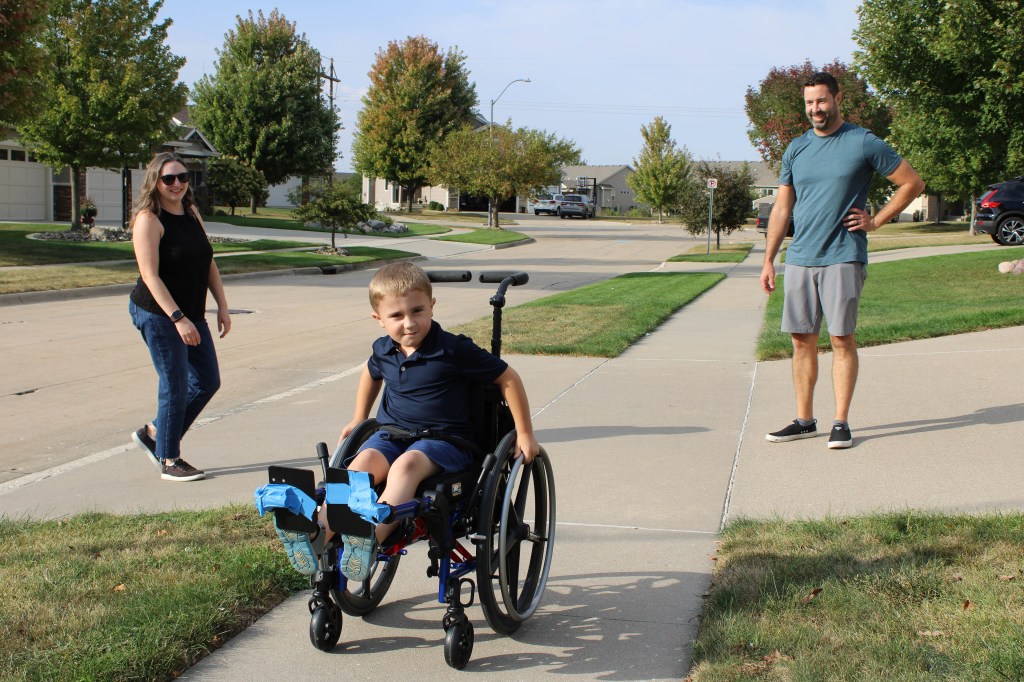
Isaac, 7, lives in Ankeny, Iowa. He has a rare condition called osteogenesis imperfecta, also known as brittle bone disease. The condition has caused about 60 bone fractures, including in his limbs, spine, and skull. It can cause intense pain and leave him unable to walk.

At times, Isaac’s disability is practically invisible, said his father, Jake Schreier. Unless he has recently suffered a broken leg bone, he walks well. “But he tires much more quickly than you or I would.”

Isaac’s doctor said he needed a special wheelchair that could be adjusted to put him in different positions depending on which bones were broken. But the private insurer that manages his Medicaid coverage declined to pay for the $3,500 wheelchair. “They required proof that it was a permanent and long-standing condition,” Jake Schreier said. “We were very frustrated.”

Schreier appealed the denial but lost. A nurse at a specialty clinic then recommended he reach out to Disability Rights Iowa, a federally funded protection and advocacy group that had helped other families in similar straits.

The group linked Schreier with two of its attorneys, who filed a new appeal. The lawyers wrote a detailed letter explaining why Isaac was legally entitled to the new wheelchair, and they cited specific Iowa codes and court precedents.

The insurer wound up paying for Isaac’s special wheelchair.

The chair allows Isaac to participate in school and community activities even when he has broken bones. “It’s absolutely night and day. I can’t imagine a world where we didn’t have it,” his father said.

Isaac may again need people like the disability rights lawyers to fight for him, so he won’t be shunted away from society, Schreier said. “We’re really trying to keep as many doors open as possible for him.”

The threat to the state-based groups’ funding comes as the Trump administration seeks to force more people with mental illness or addictions into institutions.

David Hutt, deputy executive director for legal services at the National Disability Rights Network, noted that the groups have legal authority to go into facilities where people with disabilities live, to check conditions and treatment. Those facilities include state institutions and privately owned nursing homes.

More Americans could wind up living in such settings if Trump succeeds in his quest to institutionalize people with mental illness who are living on the streets, Hutt said.

At the same time, states are facing cuts in federal contributions to Medicaid, the public health coverage program for people with low incomes or disabilities. In response, they may be tempted to reduce Medicaid coverage of community care programs, many of which are considered optional under federal law, Hutt said. If that happens, “you’re going to get increased institutionalization, which actually costs more,” he said.

Disability rights organizations often have stepped in when states failed to provide care and services that people with disabilities are entitled to. So have lawyers from the Justice Department’s civil rights division.

For example, Disability Rights Iowa filed a lawsuit in 2023 alleging the state failed to provide proper mental health resources for children on the Medicaid program. The state agreed to a settlement that advocates said could bring “radical change” to the system.

In 2021, the Justice Department warned Iowa officials that their lack of support for community services meant too many people with intellectual disabilities had to live in facilities. State officials vowed to do better.

Since Trump returned to office, many of the Justice Department’s most experienced disability rights lawyers have taken buyouts or been reassigned to other areas, said Jennifer Mathis, a former top administrator at the Justice Department under Biden. “There’s really skeleton staffing at this point,” said Mathis, now deputy director of the Bazelon Center, which advocates for rights of people with mental disabilities.

The overall civil rights division is down to about 300 people, fewer than half the number it had under Biden, Mathis said.

The civil rights division’s new director, Harmeet Dhillon, told conservative commentator Glenn Beck in April that more than 100 attorneys had left the division, but that they didn’t support Trump’s priorities. “The job here is to enforce the federal civil rights laws, not woke ideology,” she told Beck.

In a statement to KFF Health News, Dhillon said the division continues to be “a vocal and active advocate for Americans with disabilities.”

Dhillon noted the department recently sued Uber over complaints that the ride-hailing service was turning away customers with service dogs or wheelchairs; has secured agreements with Arkansas and North Carolina to improve treatment of imprisoned people with disabilities; and is investigating large bus companies over allegations of failing to provide proper accommodations for people with disabilities.

The department declined to comment on the record about the number of attorneys it has working on disability rights issues. However, it is publicly recruiting “civil rights warriors,” including lawyers, to join the civil rights division.

Jake Schreier, the Iowa parent, hopes the issue will be worked out nationally. “I really can’t believe this is anything that would be partisan,” he said.

KFF Health News is a national newsroom that produces in-depth journalism about health issues and is one of the core operating programs at KFF—an independent source of health policy research, polling, and journalism. Learn more about KFF.

USE OUR CONTENT

This story can be republished for free (details).

Readers Make Their Wish Lists, Checking Up on Health Care

Letters to the Editor is a periodic feature. We welcome all comments and will publish a selection. We edit for length and clarity and require full names.

How To Excise Politics From Health Care

More than a decade after the Affordable Care Act took effect, we’re still trapped in a confusing and costly health care maze (“Readers Take Congress to Task and Offer Their Own Health Policy Fixes,” Nov. 12). The ACA expanded coverage and protected people with preexisting conditions, but it also layered subsidies, narrow networks, and rising premiums on top of an already fragmented system. Millions still face deductibles so high that “coverage” often means financial anxiety instead of security.

The problem isn’t our doctors or hospitals — it’s the structure. America spends nearly twice as much per person on health care as other developed countries, yet our life expectancy is shorter and our outcomes worse. We’ve allowed a tangle of private insurers, billing rules, and monopoly pricing to replace coordination with chaos.

We don’t need “socialized medicine.” We need organized medicine that guarantees coverage, controls costs, and cuts red tape. Other nations have done it — efficiently, fairly, and without eliminating private choice.

Here’s what would work (with a little help from my friend ChatGPT):

1. Universal, automatic coverage. Everyone should be enrolled from birth or residency, independent of job or income. Basic care would be guaranteed, while private insurance could supplement it.

2. Rational pricing. Hospitals, doctors, and drugmakers should follow transparent, regulated price schedules — like the all-payer systems used abroad — ending the markups and cost-shifting that drive U.S. prices sky-high.

3. Streamlined administration. We spend five times as much on billing and insurance overhead as our peers. A single set of rules and electronic standards would save billions and free doctors from paperwork.

4. Invest in primary and mental health care. Paying for outcomes instead of volume would improve health and reduce preventable hospitalizations.

5. Protect families from financial ruin. National catastrophic and long-term care coverage would stop medical bills from destroying lives.

These reforms aren’t radical — they’re what nearly every successful country already does. The obstacle isn’t feasibility; it’s politics. Every dollar saved is a dollar someone currently earns, and entrenched lobbyists fight to preserve that status quo.

The ACA was a step forward, but it left us with a patchwork of subsidies, mandates, and unaffordable premiums. America already spends enough to cover everyone. The challenge now is to spend it wisely — through a rational, universal, and efficient system that works for people, not paperwork.

— Luis Albisu, Warrenton, Virginia

Beating Back Mold

There are only three ingredients to mold: spores, cellulose, and water (“A Hidden Health Crisis Following Natural Disasters: Mold Growth in Homes,” Nov. 19). The spores are floating in the air when construction is taking place. No exceptions. Cellulose is in paper and wood. Its most damaging use is in drywall or gypsum board (gyp board). A single drop of water, from a roof leak or plumbing/sewer pipe, is all that’s needed to start the mold process.

The use of drywall after World War II to build housing quickly is a primary culprit. USG and similar manufacturers make an alternative product without paper sheathing that will not react with water. USG calls it “Mold Tough,” and it uses fiberglass mat instead of paper.

As an architect, I have a simple solution: Stop the use of drywall with paper sheathing.

— Marc Brewster, Bastrop, Texas

Help Is Still Wanted

I am writing in response to the article “Help Wanted: California Looked to Them To Close Health Disparities, Then It Backpedaled” (July 28), in which Vanessa G. Sánchez explained the issues regarding health disparities among immigrant populations — such as chronic diseases, a high uninsured rate, and the more dire fact that the community health workers who do their best to support these people are paid very little for a crucial job. They offer assistance and trust to those who may not be as comfortable asking for it or are unaware that it exists because they are not from here.

She also wrote about a path opening up with the professionalization of these community health workers — how certification programs were opening up, and funding was going to increase. But it has been cut because of the budget cuts going on during this Trump administration, and programs have been slashed or abandoned.

I want to thank you for shedding light on this issue. These community health workers serve as the middle stop for health care for so many people who face immigration and language barriers. This is the workforce they appeal to and go to, and that in and of itself is honorable work that needs to be done and should be paid at a higher rate than it currently is. One could even argue it’s as important as a doctor’s visit, because even to go to the doctor, you need insurance. And who helps you with that and then sends you to the doctor? The community health workers, exactly!

I am part of the Hispanic community and care about the health disparities that exist within it, such as diabetes, and am also very aware of the language barrier that exists in the hospital field. Working together, is there a way to reinstate some certifications or training to promote higher wages and improve health for all Hispanics/immigrants?

— Avelino Cortes, San Leandro, California

Where To Draw the Line on ‘Urgent’ Care?

As a pediatric emergency medicine physician who regularly works shifts in a community hospital, I read the article on a short “nonurgent” but expensive ambulance ride for a child with interest and horror (“Bill of the Month: Not Serious Enough To Turn on the Siren, Toddler’s 39-Mile Ambulance Ride Still Cost Over $9,000,” Nov. 25). I would not have come close to guessing that an Advanced Life Support, or ALS, ambulance would cost over $9,000. Often, patients’ costs vary based on which ambulance company arrives, their insurance plan, whether they are uninsured, etc. We, at least as doctors, rarely have that information at our disposal.

I try to have parents drive their children to the referral hospital when it is safe and feasible, but this is not always possible. What risk of your child dying would you accept if you went by car? 10%? 1%? 0.1%? 0.01%? Just because no treatment was administered during this ambulance ride does not mean that the ambulance was not needed.

What makes us good at our jobs in medicine is worrying about the worst-case scenarios. Do providers sometimes overreact and send kids by ambulance who don’t need it? Absolutely. But there are also too many cases in which children die or become critically ill because someone didn’t recognize how sick the child was or the risks. If we send you in an ambulance, or admit you to the intensive care unit, because we are worried you are at risk of something like shock or respiratory failure, it doesn’t mean you will definitely need intensive care. But, if you go into shock or stop breathing while in your parents’ car, you are much less likely to survive than if we are watching for it and treat it right away. The same way that when we tell you it is a virus, after doing lots of tests, it doesn’t mean we didn’t need to do those tests. The absence of needing treatment doesn’t mean the admission or testing we recommend was unnecessary.

Perpetuating the impression that it is wasteful treatment just because everything works out well is a luxury you have when you don’t regularly see how quickly kids can go from looking relatively well to critically ill and at risk of dying. Those of us who are good at what we do know when to worry and when not to worry. Please don’t disparage our caution or treatment without even asking for our rationale. Ask this doctor why he said the baby absolutely had to go by ambulance. Maybe he didn’t have a good reason. But maybe he did. Maybe if a similar child had been sent by car and the child had gone into shock, this article would instead be talking about how incompetent he was in missing the risk of sepsis and causing the child’s death by letting the parents drive him to the hospital.

We are doing our best to provide good care in a broken, overloaded system. If we are going to work together to fix it, we all must work to understand one another’s points of view. Thank you for helping us understand these unexpected and incredibly burdensome costs our patients face. Please try to understand that caution may not be us dismissing the burden or cost but knowing the risks.

— Samantha Rosman, Boston

Investing in Your Own Health Care

About 20 years ago, I switched to a high-deductible health plan and a health savings account. It was the best decision I ever made for health care for my family (“Trump’s Idea for Health Accounts Has Been Tried. Millions of Patients Have Ended Up in Debt,” Dec. 9).

Today, after years of contributions (compounded with investment gains), the dividends and gains return a higher amount than our health care withdrawals. We’re also still contributing the max family amount per year.

We’re in the process of retiring now, and we’ll continue to select an HDHP and max out our HSA contributions. Once on Medicare, our premium payments can be made with our HSA account. Also, it’s another form of IRA once we reach age 65. It’s a double-tax-advantage account.

I don’t understand the resistance to switching to an HDHP and an HSA. The more you insure yourself, the more money you save. Long-term, it compounds into serious money. At my workplace, I try to talk as many people as possible into choosing an HDHP. They’re all so thankful years later.

I believe people are just afraid of change — not realizing it can seriously be the best health care decision they ever made.

— Tim Eckel, Toledo, Ohio

KFF Health News is a national newsroom that produces in-depth journalism about health issues and is one of the core operating programs at KFF—an independent source of health policy research, polling, and journalism. Learn more about KFF.

USE OUR CONTENT

This story can be republished for free (details).
One Big Beautiful Bill Act Complicates State Health Care Affordability Efforts

As Congress debates whether to extend the temporary federal subsidies that have helped millions of Americans buy health coverage, a crucial underlying reality is sometimes overlooked: Those subsidies are merely a band-aid covering the often unaffordable cost of health care.

California, Massachusetts, Connecticut, and five other states have set caps on health care spending in a bid to rein in the intense financial pressure felt by many families, individuals, and employers who every year face increases in premiums, deductibles, and other health-related expenses.

Hospitals and other health care providers are citing Republicans’ One Big Beautiful Bill Act, signed by President Donald Trump in July, as one more reason to challenge those limits.

The law is expected to reduce federal Medicaid spending by more than $900 billion over a decade, which mathematically should help the overall health care system meet the caps. But the law is also expected to increase the number of uninsured Americans, mostly Medicaid beneficiaries, by an estimated 10 million people. Health care analysts predict hospitals and other providers will raise prices to cover the double whammy of lost Medicaid revenue and the cost of caring for an influx of newly uninsured patients.

Whether regulators in some states will allow providers to justify higher prices and exceed the spending caps is unclear. Only California and Oregon can penalize providers financially if they fail to meet targets.

“Are we going to say, ‘That’s OK’? Or are we going to say, ‘Well, you exceeded the target. We’re still going to penalize you for that’?” said Richard Pan, a former state lawmaker and a member of the California Office of Health Care Affordability’s board. “That has not yet been decided.”

The California Hospital Association, the industry’s main state lobbying group, filed a lawsuit in October asking a state court to strike down the spending caps, which it argued fail to account for all the cost pressures hospitals face. Those pressures, it said, include an aging, sicker population; the rising cost of labor; expensive advances in medical technology; large capital outlays on required seismic retrofitting; and changes in federal policy, including the One Big Beautiful Bill Act. The hospital group’s lawsuit also asserted that the state affordability office, by hastily imposing ill-considered cost-cutting targets, was undermining its other key mission of improving health care access, quality, and equity.

California’s affordability office last year set a five-year target to cap statewide spending growth, starting at 3.5% in 2025 and declining to 3% by 2029. The annual caps apply to a wide range of health care entities, including hospitals, medical groups, insurers, and other payers.

Earlier this year, it imposed much lower spending growth caps — starting at 1.8% in 2026 and declining to 1.6% by 2029 — for seven “high-cost” hospitals.

“The spending caps set by politically appointed bureaucrats could force cuts that result in many Californians traveling farther for care, facing longer emergency room wait times, experiencing more overcrowding, and losing access to critical services,” Carmela Coyle, the hospital association’s president and CEO, said in an October press release.

The California attorney general’s office, which will represent the affordability agency, has not yet filed a response to the hospital group’s complaint and did not respond to a request for comment.

Hospitals’ Pushback

California is not the only state taking a close look at hospital prices, which are widely considered a primary driver of health care costs.

“States, armed with information that points to payments to hospitals as a driver of what is way beyond affordable commercial premiums, have begun to take increasingly targeted actions focused on commercial hospital prices,” said Michael Bailit, founder of the Needham, Massachusetts-based consultancy Bailit Health, which has advised multiple states, including California, on ways to tame health care spending. “It is not surprising that the hospital industry is going to oppose such state actions.”

In its lawsuit, the California Hospital Association said the affordability office’s own report showed that pharmaceutical and insurance companies are largely responsible for high costs.

Hospitals in some states with cost growth limits, including Connecticut and Massachusetts, have expressed objections similar to the ones raised in the California lawsuit. They could follow their counterparts in California if their lawsuit succeeds, said Peter Lee, who led California’s Affordable Care Act marketplace, Covered California, for over a decade and is now a senior scholar at Stanford Medicine’s Clinical Excellence Research Center.

Lee said the work of California’s affordability office and similar agencies in other states is just about the only systemwide effort being made to cut health care costs. They are basically saying, “‘Look, health care is taking money away from education, it is taking money away from the environment, it is taking money away from everything in the public sector, and in the private sector it is taking money away from wages,’” he said. “‘We don’t know how you, the health system, are going to do it, but it is your job not just to provide quality but to lower costs. Here’s the target.’”

To be sure, achieving the cost savings that California and those other states are seeking is no easy lift. It will ultimately require persuading large, financially powerful players that compete fiercely for health care dollars to adopt a different mindset and begin cooperating to reduce costs instead. And that, in many cases, will mean lower revenue.

But the status quo, as many people know all too well, means continued financial pain for millions.

In early 2020, Estevan Rodriguez, a bartender at California’s Monterey Beach Hotel, had surgery for a staph infection in his leg. The bill came to nearly $168,000. His insurance paid most of it, but he still owed $5,665, which took him two years to pay, more than $200 every month. “It may not be a lot to some people, but it was a lot to me,” Rodriguez said.

He said he dropped his Hulu subscription, switched to a lower-cost cellphone, and got cheaper car insurance. He started going to food banks rather than the grocery store, he said, and had a lot less time with his kids, because he was constantly working to pay off the hospital bill.

Community Hospital of the Monterey Peninsula, where Rodriguez had his surgery, is one of the seven hospitals identified by California’s affordability office as high-cost. A study by the office attributed high hospital prices in Monterey County to a lack of market competition “rather than higher operating costs or superior quality of care.”

The Monterey hospital referred a request for comment about its “high-cost” designation to the California Hospital Association. CHA spokesperson Jan Emerson-Shea declined to comment beyond the language of the lawsuit and Coyle’s press release statement.

Reduced Competition

Health care analysts worry the One Big Beautiful Bill Act will reduce market competition even further by stressing already weak hospitals, leading some to shut services, merge with larger health systems, or close. One study estimates 338 rural hospitals are at risk of closing nationwide.

Less competition, in addition to fewer Medicaid dollars and an increase in uninsured patients, will only strengthen the incentive of health systems with the requisite market clout to raise their commercial prices, increasing premiums for employers and individuals.

“We think commercial prices will continue to increase as health care providers, and hospitals in particular, will seek to preserve or increase their revenue,” said Rachel Block, a program officer at the Milbank Memorial Fund, a foundation that focuses on health equity.

That in turn could pose a challenge to state affordability regulators tasked with overseeing compliance with growth targets for health care spending.

California’s affordability office is required to consider mitigating factors, including changes in federal and state laws. But some of its board members have expressed skepticism about letting hospitals offset Medicaid losses with higher commercial prices.

“There’s a lot of talk about using HR 1 and other federal policies as an excuse to raise prices on commercial payers,” Ian Lewis, an affordability office board member and policy director for UNITE HERE Local 2, a hospitality workers union in the Bay Area, said at the agency’s July board meeting, referring to the One Big Beautiful Bill. “There’s no more blood to be squeezed from this stone.”

KFF Health News is a national newsroom that produces in-depth journalism about health issues and is one of the core operating programs at KFF—an independent source of health policy research, polling, and journalism. Learn more about KFF.

USE OUR CONTENT

This story can be republished for free (details).